Office Holiday Party Dress: The ‘Festive’ Trap That Makes You Buy the Wrong Outfit
Choose an office holiday party dress for the event you actually have. Decode the invitation, check the whole outfit, and avoid a costly one-night purchase.

Office holiday party dress: the ‘festive’ trap that makes you buy the wrong outfit
It is 11:43 p.m. The invitation is open in one tab. A silver dress is open in another.
The dress has a low back, beautiful movement, and a delivery date that looks just possible. The invitation has a restaurant address and two words doing an unreasonable amount of work: festive attire.
You zoom in. You check the size chart. You imagine walking through the door.
Then you remember you have never seen your colleagues outside a video call.
Before choosing an office holiday party dress, establish the event's actual dress code and activities, then try the complete outfit with the shoes, support, and layers you intend to use. For an office lunch, that may mean a familiar work dress with one celebratory detail. For a cocktail reception, it may mean a dressier knee-length or midi dress. A formal gala needs its own brief.
The expensive mistake is buying the feeling of a holiday party before finding out which party you are attending.
You can solve that before anything reaches your cart.
“Festive” describes a mood; you still need a dress code
A sparkle filter cannot tell you whether dinner takes place in the staff kitchen or a hotel ballroom.
Start with the invitation's exact wording. Then look at the time, venue, and schedule. Are people arriving straight from work? Is there a seated dinner? Will you be standing for a reception, moving between rooms, or spending part of the evening outside?
Those details narrow the choice. They do not automatically decide it. A grand building can host a casual gathering, and a company with relaxed everyday clothes can organize a formal evening.
In a recent discussion about a formal company holiday party, a guest arriving as a plus-one knew the venue and that her date would wear a suit, but still did not know what to choose. A useful response suggested looking at photographs from the same event in previous years. That is context you can actually use, provided this year's invitation has not changed the expectations.
Ask the organizer a specific question:
“When the invitation says festive, are people usually in everyday work clothes with accessories, cocktail dresses and suits, or formal eveningwear?”
If you are a plus-one, have your host ask. If the event has explicit clothing requirements, use those as the starting point.
There is nothing embarrassing about clarifying an ambiguous brief. It is considerably easier than interpreting six product photographs and hoping.
Choose the event first and the dress second
Use these as outfit starting points, then adjust for the actual invitation, your preferences, and the way your workplace celebrates.
An office lunch usually needs less transformation than your shopping feed suggests
Start with something you already feel comfortable wearing at work: a knit dress, a tailored shift, or another familiar outfit. Add a detail you enjoy, such as earrings, a colorful shoe, or a patterned scarf.
If the invitation specifically calls for novelty sweaters or a theme, follow that brief instead. You do not need to manufacture an evening event out of a lunchtime celebration.
A restaurant dinner needs an outfit that works while seated
A softly structured midi dress, a simple knee-length dress, or polished separates can give you a useful starting point when the event is described as smart casual or dressy casual.
Try sitting at a table. Notice whether the waist presses, the neckline shifts, or the sleeves get in your way. The silhouette you see standing in front of a mirror is only part of the evening.
A restaurant address alone does not justify a cocktail dress. Check what the host actually requested.
A cocktail reception gives you room for an evening dress
An office party cocktail dress might have a richer texture, a sculpted neckline, or some shimmer. A dressy jumpsuit or suit can also work when it fits the invitation.
For more detail on silhouettes and fabrics, our cocktail attire dress guide explains the category. Apply the dress-code guidance to your company event; wedding-specific color etiquette is a separate question.
A formal gala deserves a clear answer about formality
If the invitation says black tie, plan for formal eveningwear, commonly a floor-length gown or an appropriately formal alternative. If it says only formal, ask whether the organizer expects long gowns or also welcomes cocktail-length dresses.
Adding a glittery bag to an everyday dress does not reliably turn it into formal eveningwear. Equally, a gown is not automatically the right answer because the event happens in December.
Jovani's holiday dress guide makes the useful distinction between office gatherings, cocktail events, and black-tie celebrations. Treat retailer ideas as inspiration after the host's brief is clear.
You do not have to disappear to look appropriate
A lot of advice about what to wear to a work holiday party sounds like a list of ways to become less visible.
You are allowed to enjoy the clothes.
Color, shape, texture, and sparkle can all be part of a thoughtful work Christmas party outfit. The useful question is whether the outfit fits the event and lets you participate comfortably. Your body is not an etiquette problem to solve.
For an easy starting point, choose the feature you most want to wear. Perhaps it is a cobalt dress, velvet fabric, a dramatic sleeve, or a bright pair of earrings. Build the rest of the outfit around that feature using pieces you already understand.
This is a way to simplify decisions, not a rule that only one interesting thing is allowed.
If you love a sequin dress and the invitation supports it, try it. Check how the fabric feels against your arms and how it behaves under your jacket. If you prefer an understated black dress, you do not owe anyone a metallic upgrade.
Personal coverage preferences matter too. Choose a neckline, back, and hem you feel comfortable wearing while sitting, reaching, and talking. Someone else's comfort threshold does not have to become yours.
The goal is to arrive feeling like yourself, with enough attention left for the people in the room.
The whole outfit has to work when your hands are occupied
Imagine holding a small plate in one hand and greeting someone with the other.
Now imagine also needing to hold your wrap in place, pull down your hem, and stop a strap from slipping.
That is useful information to discover at home.
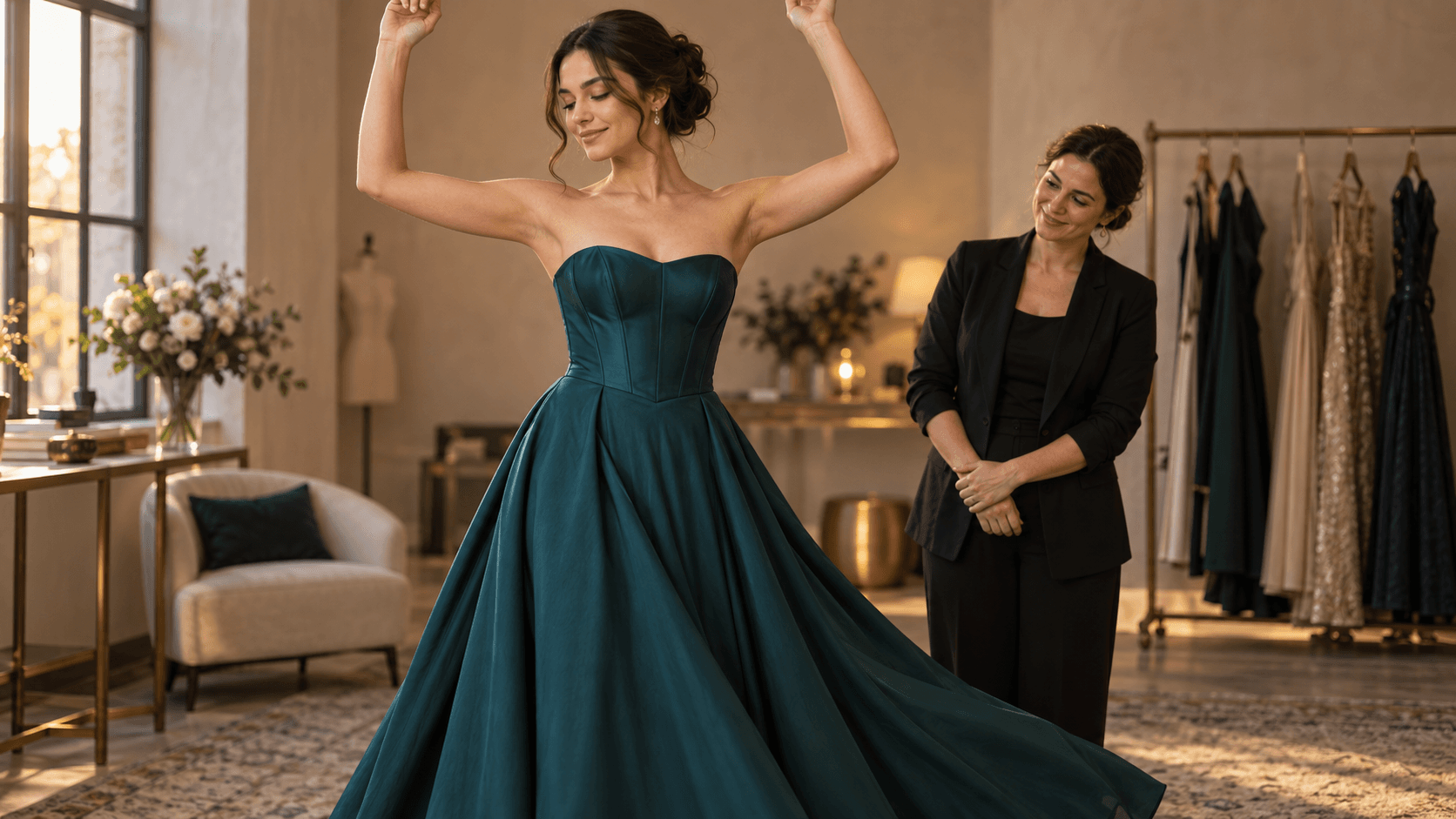
Before removing tags, try the entire outfit indoors in a way that respects the retailer's return conditions. Use the actual shoes, undergarments, bag, and jacket you plan to wear. Then rehearse the ordinary parts of the event:
- Sit for several minutes. Check comfort at the waist, back, and neckline without arranging the dress into a special pose.
- Walk and turn. Notice whether the skirt catches, the lining moves, or the shoes change how you walk.
- Reach naturally. Pick something up from a table and lift your arms as you would when putting on a coat.
- Carry your things. Confirm your bag holds what you need and that you can manage it without continually readjusting your clothes.
- Remove the outer layer. Make sure you like the outfit you will actually wear inside.
If something needs fixing, name the change. “The straps need shortening” is a task you can have assessed. “I will remember not to move that way” is a very long evening.
For sheer or thin fabrics, check the dress in ordinary room light with the intended underlayers. Our guide to what to wear under a see-through dress can help you plan coverage without buying several things at random.
The coat and commute belong in the purchase decision
The restaurant photograph does not show the walk from the station.
Think through the trip you will actually make: work to venue, venue to home, and any time waiting outdoors. Choose footwear and outerwear for those conditions, and arrange a practical place for anything you change out of.
If your dress works only with a delicate evening wrap, but your journey needs a warm coat, try the coat over the dress before deciding. Check that sleeves fit inside it and that you can close it comfortably.
Our guide to what to wear over a formal dress when cold goes deeper on that choice.
For an event straight after work, keep the transition realistic. A dress you can wear all day with a jacket and restyle with earrings may be easier than a full change in a tiny bathroom. If you do plan to change, establish where and when.
The party starts when you arrive. The outfit starts working much earlier.
A cheap dress can bring an expensive shopping list
Before buying, list everything you need to wear that particular dress comfortably.
Include necessary alterations, missing support or lining, suitable footwear, and delivery. Separate those essentials from accessories you simply fancy adding.
A dress that requires new shoes, a new bra, and a new jacket may cost more to use than a higher-priced dress that works with what you own. The ticket price does not settle the comparison.
Try a wardrobe rehearsal first. Put on an existing dress with the styling you would give a new purchase. Take a photograph if it helps. Sometimes the missing element is a finished outfit, not a different garment.
If you still want something new, consider where else you would choose to wear it. Name an actual kind of occasion in your life. “I could wear this anywhere” often falls apart when you try to name somewhere.
For an online order, check the item's current return conditions and leave time for a try-on, a return if needed, and any agreed alteration work. A delivery estimate on the day before the party gives you very little room to respond.
Renting or borrowing may also suit the occasion. Confirm fit, collection or delivery timing, and the applicable return arrangements before relying on either option.
Save a five-line brief before opening another shopping tab
Write this in your phone:
- Event: actual dress code, venue, start time, and main activities.
- Dress: the silhouette, coverage, and standout detail I want.
- Comfort: shoes, support, sitting, reaching, and carrying my things.
- Journey: coat, travel, changing arrangements, and storage.
- Purchase: complete cost, try-on deadline, return terms, and likely reuse.
An unanswered line tells you what to investigate next. It does not mean you need another hour of scrolling.
If you have a clear idea but cannot explain the design, you can upload a dress reference or explore a dress concept. Use the result to clarify the neckline, sleeves, or silhouette you want; a concept still needs a separate assessment of construction, fit, cost, and timing before it becomes a garment.
When the five lines are clear, choose the outfit you are excited to wear.
Then close the shopping tabs. There is a party to look forward to.