That Dream Gown Might Not Exist: How to Find a Dress From a Picture
Trying to find a dress from a picture? Trace its source, verify the seller, and turn an unverified or AI gown into a realistic shopping brief.
That dream gown might not exist: how to find a dress from a picture
The screen is the only light left in the room.
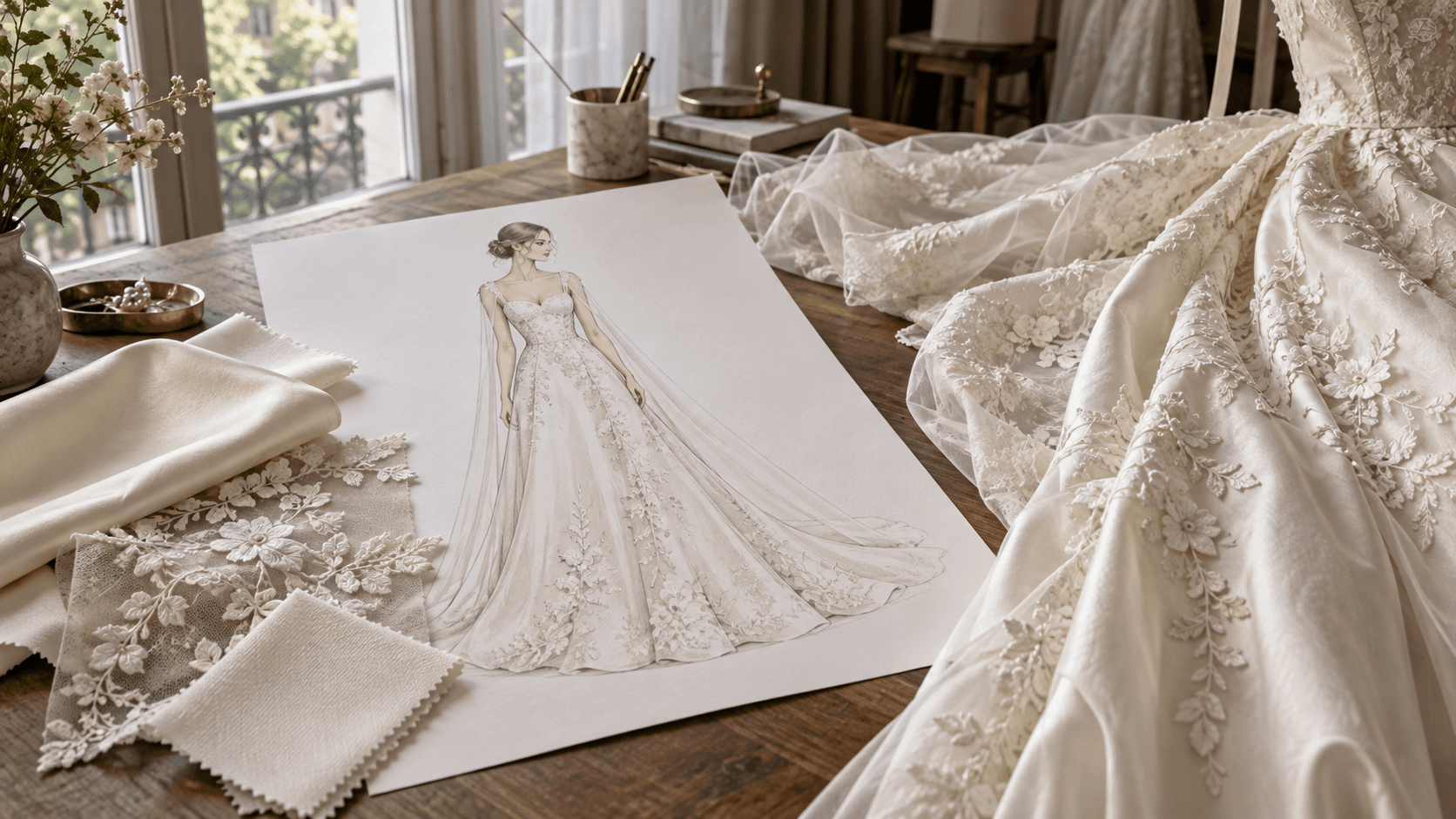
You have closed three shopping tabs. You have almost given up. Then a gown appears: an ivory skirt falling like folded paper, a square neckline, lace drifting over the shoulders without looking heavy.
There it is.
Not a dress you could tolerate. The dress you have been trying to explain.
You save the picture. Tap the link. Land on a page selling something vaguely similar. Search again. Find the same image on six accounts, under six different names, at six wildly different prices.
The excitement turns into a small, stubborn question: where can you actually buy it?
To find a dress from a picture, start by tracing the image to a named designer, maker, or original wearer. Use reverse image search to gather leads, then verify the garment and seller separately. If you cannot establish a source, treat the picture as inspiration—not as proof that an exact gown exists or can be delivered.
That last distinction can save more than money.
It can save weeks spent chasing a screenshot while real, wearable options slip past.
A beautiful image is not a product listing
An inspiration picture can show several different things:
- a real gown currently available from its designer
- a discontinued style, vintage find, or one-off custom commission
- a real dress changed with alterations, accessories, editing, or virtual try-on
- an illustration, rendering, or AI-generated concept
- a photograph reused by a seller who did not make the garment
These situations can look similar in a search feed. They require different next steps.
A visual match answers, “What looks like this?” It does not automatically answer, “Who made this?” or “Will this shop send me this exact dress?”
Keep those three questions separate. Otherwise, a convincing thumbnail can start doing the work of a designer name, a construction specification, and a purchase agreement.
It is not qualified for any of those jobs.
Save the clues before cropping them away
Keep one copy of the complete image and one close crop of the dress.
The crop helps you search the garment. The full image may preserve the clues that identify it: a photographer credit, a boutique tag, the original caption, an event location, or another person wearing the same collection.
Save the page link too. A screenshot with no source is harder to investigate than a photograph attached to an account and a caption.
If the picture came from Pinterest, follow the destination link rather than assuming the pin's description names the designer. If it came from a wedding feature, look through the vendor credits. If it came from a real person's post, check the caption and tagged accounts before asking strangers to identify it.
Do not crop off a watermark in your only saved copy. Do not assume a retailer logo added over the image proves ownership. Preserve the evidence first; tidy it later.
For a private photo, crop out faces, names, and unrelated identifying details before uploading it to a search service or public dress-ID community. Use only what you have permission to share.
Reverse image search finds leads; you still have to follow them
Google Lens is a useful first pass. On a computer, open Google, select the image-search icon, and upload the saved picture. You can also search using an image URL. Google's results can include similar images and websites containing the image or a similar one—not just an exact product. Its official image-search guide explains the current upload steps and how to add words to the search.
Try the complete image first. Then try a dress-only crop.
If the results are crowded with bouquets, venues, jewelry, or lookalike gowns, narrow your query with two or three visible features:
- ivory square-neck A-line gown
- black floral lace wedding dress cape
- blue satin midi dress bow back
- strapless drop-waist gown pleated skirt
Search a distinctive detail separately if necessary. The cape, lace gloves, or overskirt might have a different source from the dress beneath it.
Then leave the image grid.
Open the promising pages. Look for a collection name, style number, designer credit, additional angles, or a link back to the maker. Follow that trail to an official source rather than stopping at the first checkout button.
A page repeating the same photograph is another lead, not independent confirmation. A dozen repetitions of one image are still one image.
The missing designer may be hiding in the outfit, not the algorithm
Sometimes the dress you are searching for is actually a dress plus three other decisions.
An opaque gown beneath a lace topper. A removable cape falling over narrow straps. A separate overskirt creating a ball-gown shape. Gloves making a sleeveless bodice appear to have long sleeves.
Search the base garment and the additions independently.
Also separate what the photograph shows from what you are inferring. A smooth, shiny surface does not tell you the fiber content. A tightly clipped salon sample does not show how the ordered size will sit. A low back does not reveal the hidden support holding the front in place.
Write down the visible facts:
Square neckline. Narrow straps. Full pleated skirt. Lace cape. No visible train in this angle.
Then write down the unknowns:
Fabric composition. Closure. Bodice support. Lining. Cape attachment. Actual train length.
This small split makes your next search—or your conversation with a boutique—much sharper.
It also prevents you from ordering a gown based on details the camera never established.
Ask for a dress ID that someone can actually solve
If visual search stalls, a dress-ID community or bridal stylist may help. Give them a useful request, not just a picture and “Need this.”
Include the original link if you have it, the searches you already tried, and whether you want the exact designer or a similar style. Add your country, budget, event date, and required size range if you are also asking for purchase options.
Try this:
I am trying to identify the designer of this square-neck gown. The image came from this wedding feature, but I could not find a dress credit. Lens returned similar skirts, not the same neckline. I would also consider a similar A-line gown available in the UK, up to £1,200, in my size, for an event next spring. The lace cape matters more to me than the exact embroidery.
Now someone can help with the real problem.
The answer may be a stockist. It may be a separate accessory. It may be a discontinued collection. It may be, “No verified source yet.”
That last answer is useful. It tells you not to convert uncertainty into a deposit.
No match does not prove the picture is AI
This is where a frustrating search can turn into an unfair accusation.
A real dress may be vintage, custom-made, altered, photographed before a collection launches, or simply absent from the pages your search found. Failure to identify it is not proof that it is fake.
Equally, a polished image is not proof that it is a photograph of a finished garment.
Treat visual oddities as questions to investigate, not a verdict. Lace that appears to change between views, unclear seam joins, inconsistent closures, or a skirt behaving differently in every image are reasons to ask for better evidence. They do not give you a reliable authenticity score.
More useful questions are practical:
- Is the source openly labeling the image as a concept, render, or AI visualization?
- Can a named maker provide photographs or video of the physical garment?
- Do the front, side, and back views describe the same construction?
- Can the seller explain the fabric, lining, closure, and support?
- Are the photographs examples of that seller's work, or references they intend to interpret?
If those questions remain unanswered, mark the image unverified.
You can still love it. You just should not shop as though its existence, construction, and delivery have already been confirmed.
Verify the seller even after you find the gown
Finding a designer name is progress. Finding that name in a shop's description is not enough.
For a branded gown, check the designer's own website and stockist information. Contact the designer or boutique through independently found details if a listing is unclear. Ask whether the listing is an original garment, a resale item, or an interpretation of a reference.
The FTC recommends searching an unfamiliar seller's name and website address with words such as “review,” “complaint,” or “scam.” It also advises checking delivery and return terms and considering credit-card payment protections. See its online-shopping scam guidance.
Before paying, save the exact listing, promised delivery date, total cost, customization terms, and return conditions. Look for customer photographs and consistent evidence of the seller's own finished work, while remembering that reviews alone are not proof.
For a longer buying checklist, our online formal-dress shopping guide covers sizing, seller checks, timing, and return-policy details. The occasion may differ; the need to verify a purchase does not.
Put your search into one of three outcomes
You do not need an endless investigation. You need to know which kind of decision you are making.
You found the exact, traceable product
Record the designer, style name or number, official product page, and verified purchasing route. Confirm current availability, sizing, total price, delivery, and any alteration needs directly with the seller.
Do not assume an old listing means the gown is still in production or available in your size.
You found a real gown that is no longer easy to buy
Look for verified resale, samples, a newer style with the same important features, or separate accessories that recreate the outfit's overall composition.
Decide which detail you would actually miss. If it is the neckline and skirt proportions, an exact lace motif may not deserve another month of searching.
You found no verified physical garment
Stop treating the image as a missing product link. Turn it into a design brief.
That is not settling. It is changing the job from “locate this exact item” to “make these specific features work in real life.”
And that job has answers a screenshot cannot supply.
Keep the feeling; rewrite the physics
The useful part of an unverified image may be entirely real: the contrast between a clean bodice and airy skirt, the quiet neckline, the movement of a cape, the depth of lace over a tonal lining.
Name those priorities. Then ask what construction can achieve them.
If you want a dramatic low back and a supportive front, ask how the support will work. If you want a floating skirt, ask to see a fabric sample moving. If you want lace coverage without opacity surprises, specify where lining begins and ends. If you want sleeves, explain the movement you need for hugging, reaching, and dancing.
Our dress fabric guide can help you describe drape, weight, stretch, and opacity rather than relying on a picture's surface effect.
When a recognizable designer gown is involved, aim for an original interpretation of the features you love rather than an exact branded reproduction. Our designer-inspired dress guide explains that distinction.
The goal is not to make fabric obey every pixel.
The goal is to make a dress you can wear.
Copy this brief before asking for a custom dress from a photo
Use the image as one reference, then add the information it cannot show:
Reference status: Inspiration image; original maker not verified. I want an original interpretation, not a promise of an exact replica.
Three priorities: A softly squared neckline, a structured A-line skirt with clean pleats, and a removable floral lace cape.
Fabric behavior: A skirt that holds its shape without feeling rigid. Please propose suitable fabrics and show the surface and movement of physical samples.
Coverage and support: Opaque bodice and skirt in daylight. Explain the internal bodice support, back closure, and cape attachment before production.
What can change: Lace motif, cape length, and skirt volume. No heavy hand beading. A shorter train is acceptable.
Budget and timing: My total dress budget is [amount], including the agreed shipping and alteration allowance. My event is [date]. Please confirm a realistic delivery plan and any exclusions before I commit.
Approval evidence: Fabric options, a confirmed design specification, and agreed photographs of the physical dress as it is completed.
The brackets are for your numbers, not an invitation to leave the hard questions vague.
Ask which features drive the estimate and which revisions would change it. The custom dress cost guide can help you prepare for that conversation without mistaking a reference image for a fixed-price quote.
Build-a-Dress lets you upload inspiration and describe what matters or start from a written dress brief. An AI-assisted design image is a visual reference—not a finished sewing pattern or a guarantee that every pictured detail will be reproduced exactly. Our guide to how Build-a-Dress works explains how design, quoting, measurements, and coordinated production fit together.
Use that distinction to ask better questions, whichever maker you choose.
A delivery deadline matters more than a perfect search result
Once the event date is close, another evening of image hunting has a cost.
Ask any seller or maker for a written plan covering design approval, production or dispatch, shipping, arrival, and time for a local fitting. Work backward from your event and leave room for delays. Do not assume “rush” means every step can be compressed safely.
If the plan does not fit, look at in-stock gowns, local samples, verified resale, or an outfit built from an available dress and a separate accessory. Confirm fit and availability instead of relying on a hopeful delivery estimate.
A good alternative preserves your most important features while respecting the calendar.
An impossible promise preserves the picture and risks the entire event.
The screenshot should become a starting point, not a trap
Return to the image you saved in the dark.
Maybe you now have a designer and a boutique appointment. Maybe you have learned that the cape is separate. Maybe the gown was a concept all along, but the square neckline, pleated skirt, and lightness at the shoulders still tell you exactly what you want.
That is progress.
You do not have to abandon a dress idea because you cannot find its checkout page. You do have to separate affection from evidence.
Trace the source. Verify the seller. Name the features. Confirm the physical plan.
Then let the screen go dark.
The next version of that dress should give you something a screenshot never could: fabric you can touch, a fit you can assess, and a clear answer to what will arrive.