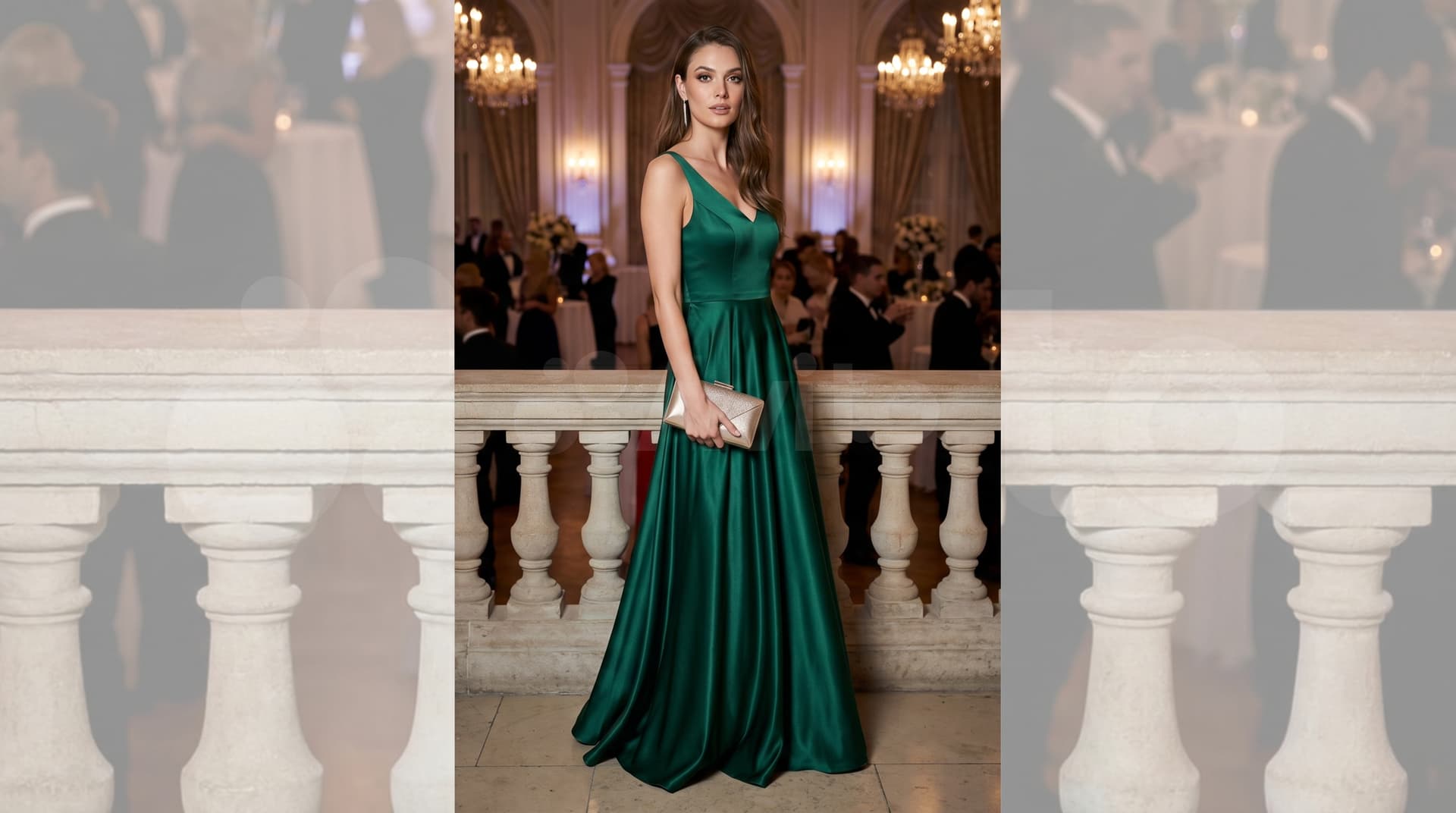
What to Wear Over a Formal Dress When Cold: The Pretty Wrap Trap
Choose what to wear over a formal dress when cold: compare coats, wraps and jackets, check the fit, and plan warm layers for a wedding or evening event.
What to wear over a formal dress when cold: the pretty wrap trap
The invitation said garden ceremony. The forecast says you should have asked more questions.
Your dress is hanging on the wardrobe door. Your shoes are ready. Across your bed lies a gauzy wrap in exactly the right shade, bought because the product photo made it look like the answer.
Then you hold it up to the window.
You can see the trees through it.
If you are deciding what to wear over a formal dress when cold, start with the time you will spend outside. A substantial coat is a sensible starting point for a cold outdoor ceremony or a long wait for transport. A lined jacket, cape, or dense wrap may suit milder conditions. A sheer shawl offers coverage and decoration, with limited warmth.
The trap is buying something that looks wintery without checking whether it will keep you comfortable.
You do not need to replace a dress you love. You need to give its outer layer the same attention you gave its neckline.
Buy for the longest wait, not the shortest walk
In your imagined evening, you step from a heated car into a glowing doorway.
In the actual evening, someone has the wrong entrance. The ceremony starts late. The group photograph needs one more cousin. Your ride is twelve minutes away, then sixteen.
Before shopping for a wedding guest dress cover-up, find out:
- Is the ceremony indoors, outdoors, or in a space with open sides?
- How long will you be seated outside, including arrival time?
- Are drinks, photographs, or the walk between venues outdoors?
- Is there a coat check or somewhere dry to leave a substantial layer?
- What weather is expected at departure, including wind and rain?
The answers can change your purchase more than the dress color does.
For a mostly indoor evening with brief transfers, you might wear a warm travel coat and carry a smaller wrap for the reception. For an outdoor ceremony, choose an outer layer you are happy to keep on throughout it. If conditions are severe, prioritize weather protection and confirm the venue's indoor backup.
There is no universal temperature at which every shawl stops working. Fabric, wind, time outside, and your own comfort all matter. A light breeze during a standing arrival is different from sitting still for forty minutes.
Our fall wedding guest dress guide covers choosing the dress itself. Here, the question is what happens after you put something over it.
A beautiful wrap can still be the wrong purchase
The word “wrap” tells you very little about warmth.
A sheer chiffon rectangle and a substantial woven wool wrap can share a product category while doing very different jobs. “Evening” describes styling. “Winter wedding” in a listing is not an insulation rating.
Check the fiber label, but also inspect thickness, weave, lining, coverage, and how the garment closes. A loosely knitted piece can admit plenty of air. A wide wrap can leave your front exposed whenever you reach. A plush stole may cover your shoulders beautifully while leaving most of your arms bare.
Adrianna Papell's formal cover-up guide distinguishes light coverage fabrics from heavier options and includes evening jackets, capes, and boleros. Use those categories to narrow the search, then examine the actual garment.
A useful starting shortlist is:
- A substantial evening coat: for cold arrivals, outdoor waiting, or a ceremony where you need coverage that stays put.
- A lined evening jacket or dressy blazer: for milder conditions and an outfit that benefits from sleeves and a secure closure.
- A dense wool or cashmere wrap: for adjustable coverage when you can keep it arranged comfortably; check its weight and size.
- A substantial cape with a reliable fastening: for dresses whose sleeves or shoulder details need space; check what remains exposed when you move.
- A light bolero or sheer shawl: for shoulder coverage or a finishing detail, with a separate warm coat when the weather requires one.
These are starting points, not promises. A thin coat can be less useful than a dense wrap. Read beyond the name.
Your coat has to fit the dress underneath it
A coat that fits over a T-shirt has not auditioned for this job.
Put it on over the actual dress, with the undergarments you intend to wear. Fasten it. Sit down. Reach forward as if accepting a plate. Cross your arms. Take it off without assistance.
Look for pulling across the upper back, tightness at the armholes, a closure that strains, or a skirt pushed into awkward folds. If you can only wear the coat open, you have learned something important about its usefulness in the cold.
The dress can create its own problems inside the layer:
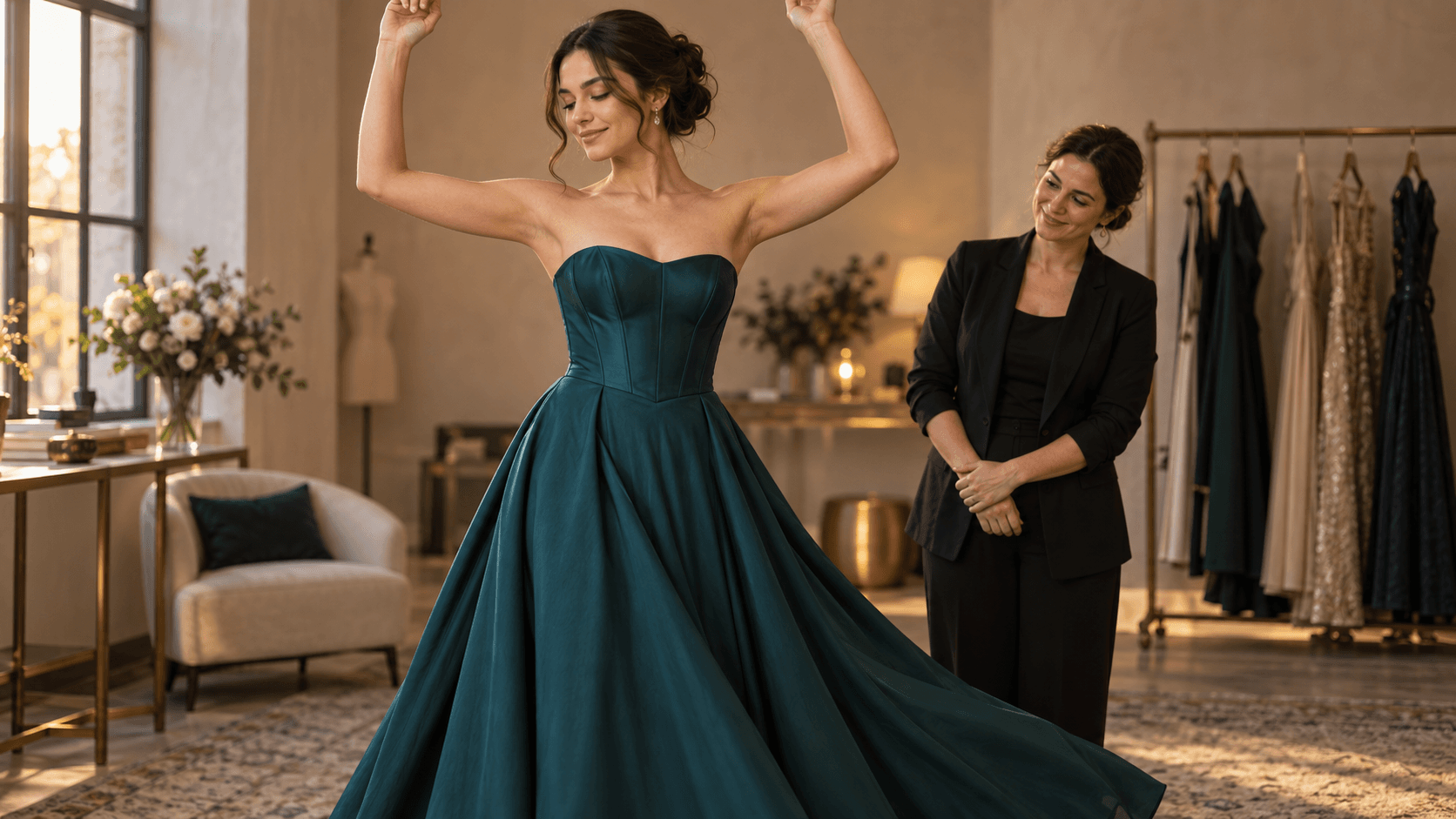
A full skirt needs room to keep its shape
An A-line dress can bunch beneath a narrow coat. Try a coat with enough sweep, or a shorter jacket that finishes before the skirt's fullest area. A cape is another possibility if its coverage suits the weather.
Do not insist on a smaller outer layer just to reveal your waist. Choose the shape that lets both garments sit naturally.
Statement sleeves need an exit route
Puff sleeves, bows, or sculptural shoulders may collapse inside fitted sleeves. A roomier armhole or cape can help, but rehearse removing the layer. Beading and delicate edges can catch on closures, jewelry, or rough lining.
If you are still choosing the gown, our guide to dresses for weddings with sleeves can help you think through the sleeve design before shopping for its outer layer.
Smooth dresses reveal what rubs against them
A close-fitting satin or crepe dress may cling, ride up, or crease where the outer layer catches it. Walk and sit in the combination, then remove the coat and inspect the dress again.
A garment that looks wonderful separately can still be an awkward partner.
Stop treating a visible dress hem as a mistake
A coat does not have to reach the floor just because the dress does.
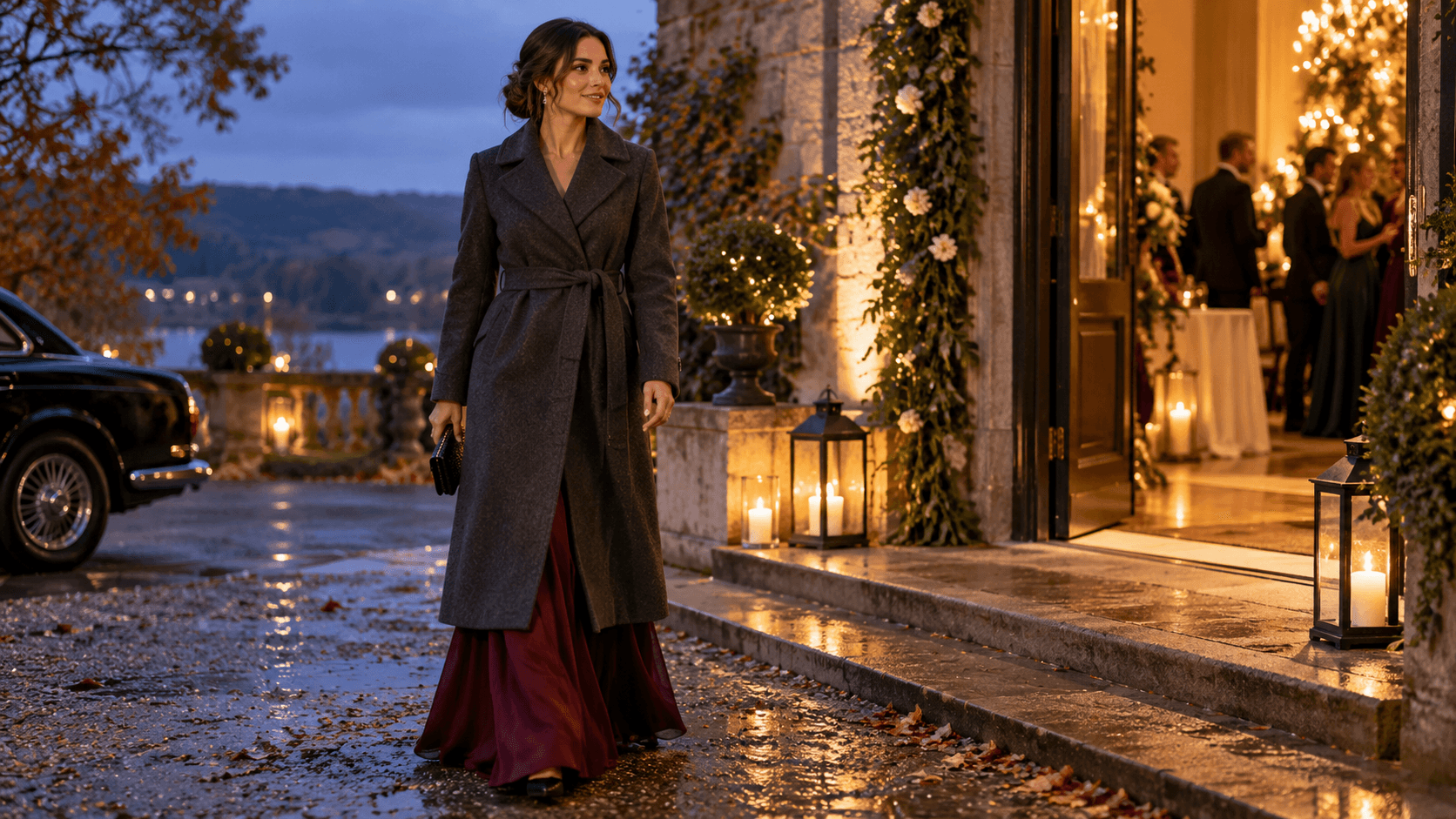
What matters is whether the combination looks considered and lets you move. A long, clean-lined coat over an evening gown can work with some skirt visible beneath it. A cropped evening jacket can emphasize a defined waist. A mid-length layer may be exactly right for one silhouette and interrupt another in a way you dislike.
There is no need to turn that preference into a universal rule.
Photograph the complete outfit from the front and side, with the coat both open and closed. Look at the actual proportions instead of trying to remember a diagram about the “correct” hem length.
Try one simple visual connection: a repeated color, a compatible texture, or similarly clean lines. Charcoal over burgundy, navy over a tonal blue dress, or black over a jewel-toned gown can be starting points. Exact matching is optional.
If the event's formality is unclear, settle that separately. Our black-tie optional guide explains the dress-code question; a warm coat cannot resolve contradictory invitation wording.
A shawl that needs one hand has a hidden cost
In a photograph, your hands are free to arrange the fabric.
At a wedding, one holds a bag. The other accepts a drink, a program, a child's hand, or someone's enthusiastic greeting.
Now the wrap slips.
Try yours while carrying the things you actually expect to carry. Reach for your phone. Sit with it on. Stand up again. If you have to trap it under your elbows, decide whether you want that job for an entire ceremony.
A suitable fastening may help, but test it first. Do not push a brooch through delicate fabric simply because you are leaving in five minutes. Check whether the wrap can be secured without damage or pulling. A jacket with sleeves may be the easier choice if you want both hands available.
The Knot's guide to wedding guest layers considers both dress code and practical warmth. The useful takeaway is to make the layer an intentional part of the outfit. That includes how it behaves when you are busy enjoying yourself.
Two layers can solve the problem more cheaply than one perfect purchase
You may already own the coat you need for the journey.
Before buying a special-occasion replacement, try it with the dress. Check fit, condition, and weather suitability. If it works for transport but you would prefer a lighter piece at dinner, separate those jobs: a substantial outer coat for outside, then a smaller wrap or jacket indoors.
That can be more useful than asking one delicate accessory to handle everything.
Borrowing is also worth considering, especially for a rarely worn evening coat. Try the borrowed piece early enough to check size, condition, and care requirements. If renting, check arrival and return dates and the provider's rules before booking.
Keep your spending focused on the missing function. If your existing coat is warm, fits over the dress, and comes off at the door, a new coat may add little to the evening. If the ceremony is outdoors and your current option cannot close, the need is more concrete.
Run the complete outfit through an ordinary evening
Before removing tags, check the retailer's try-on and return conditions. Keep everything clean and avoid adhesives or alterations during a returnable fitting.
Then rehearse these five moments:
- Arrival: put on the dress, shoes, bag, and outer layer. Fasten the layer without rearranging the gown into a different shape.
- The greeting: reach forward and move your arms as you would for a hug. Check the shoulders, sleeves, and closures.
- The ceremony: sit fully in a chair with the layer on. Notice whether the dress bunches or the wrap falls away.
- The handover: take the layer off and hold it with your bag. Check whether it snags or is too cumbersome to manage.
- Departure: put it back on without a mirror or a helper. Confirm you can still move comfortably when everything is fastened.
A home rehearsal checks fit and handling. It cannot guarantee warmth in different weather, so use the forecast and venue details to make that decision closer to the event.
If the combination fails, name the specific problem: “The sleeves are compressed,” “I cannot close it over the skirt,” or “I need both hands to keep this wrap on.” Those observations make the next purchase easier.
Put the layer into your dress brief before it becomes an emergency
If you are planning a custom dress, mention outerwear at the start.
A useful brief might read:
I want a burgundy formal dress for an autumn wedding, with a defined waist and enough ease to sit comfortably. I expect an outdoor ceremony and plan to wear my charcoal coat. Keep the shoulder and sleeve details compatible with that coat, and help me assess whether the skirt volume will fit beneath it. I will confirm the forecast and test the actual garments together before the event.
Include photographs of the coat, its relevant measurements, the dress code, the date, and the kind of coverage you prefer. Ask what needs an actual fitting rather than relying on a visual mockup.
You can start a dress design or upload a reference image to explore the look. A generated image can help communicate a silhouette; it cannot verify warmth, construction, or the fit of two finished garments together.
The goal is a dress that belongs in your real evening, with room for the layer that gets you there.
Let the coat be part of the entrance
Go back to the dress hanging on the wardrobe door.
Keep the gauzy wrap if you love it and have a use for it. Give it the indoor moment it was made for. Then choose the outer layer for the weather you will actually encounter.
Close it over the dress. Pick up your bag. Reach for the door.
You should be thinking about the people waiting inside, not how long you can pretend you are warm.