How to Keep a Strapless Dress Up—Before Fashion Tape Betrays You
Learn how to keep a strapless dress up with a seven-minute movement test, better bodice support, smart alterations, and safer fashion-tape backup.

How to keep a strapless dress up—before fashion tape betrays you
At 8:14 P.M., the dress is still perfect.
You have taken the photos. You have survived dinner. The first song you actually want to dance to comes on, and you lift both arms without thinking.
The bodice drops half an inch.
One hand stays in the air. The other catches the neckline.
From then on, the dress has your full attention. You tug after every hug. You hold your shoulders strangely. You decline the dramatic dance move you practiced in the kitchen because the tiny strips of tape that felt indestructible at home are now warm, damp, and negotiating their resignation.
This is not how a secure strapless dress is supposed to work.
To keep a strapless dress up, the dress needs to fit and anchor around your torso, with enough internal structure to carry its own weight. Fashion tape can steady an edge that already fits. It cannot turn a loose, heavy, or poorly shaped bodice into a load-bearing one.
Before you trust the dress at a wedding, prom, gala, or homecoming, run the seven-minute movement test below. It will tell you whether you need tape, a different undergarment, an alteration, or a different dress—while you still have time to act.
The neckline is not supposed to do all the work
A strapless neckline looks like the top of the system. Structurally, it is closer to the finish line.
The real work happens lower down. A well-built strapless bodice may use close fitting through the upper torso and waist, shaped seams, boning, an inner foundation, cups, gripper elastic, and a waist stay. Those elements distribute the gown's weight instead of asking the top edge to cling to skin.
Threads explains that strapless and off-the-shoulder gowns need inner support, sometimes through a separate corselet built with boning and a grosgrain-ribbon waist stay. The exact construction varies, but the principle is useful even when you are buying rather than sewing: support should be designed into the garment.
That is why “make it tighter” is not a complete answer.
A bodice can be painfully tight at the neckline and still slide. It can fit your waist but gape at the bust. It can contain boning that is too flexible, too short, or positioned badly for your torso. A heavy skirt can pull against a light bodice. A strapless bra can move separately beneath the dress and create two unstable layers instead of one stable system.
Security is not the same as compression.
The goal is a dress that stays in position while you breathe, sit, reach, and dance—not one that wins a standoff against your ribs.
Run this seven-minute test before the return window closes
Do not test a strapless dress by standing still and admiring the front view.
Wear it the way you will wear it. Put on the exact bra, cups, shapewear, hosiery, and shoes you expect to use. If you are still comparing undergarments, test each setup separately instead of stacking every possible solution at once.
Fasten the dress completely. Settle it at the intended waist and bust position. Do not begin with fashion tape; you are testing the dress first.
Then start the timer.
Minute one: breathe normally, then deeply
Take five slow breaths. Talk. Laugh. Exhale fully.
Watch what happens when your rib cage changes. A secure bodice should allow breathing without dropping to a new resting point. If the dress descends every time you exhale and stays there, the fit or anchoring needs attention.
Minute two: raise both arms
Lift your arms overhead five times. Reach forward, then out to each side.
Do not perform the careful half-reach you invented for the fitting room. Reach for an imaginary bouquet on a high shelf. Wave to someone across a ballroom. Make the movement large enough to reveal whether the dress travels.
Minute three: hug yourself
Cross your arms firmly, then open them wide. Rotate your shoulders. Pretend you are hugging someone without protecting the neckline.
This often reveals gaping at the top edge, pressure near the armholes, or a bodice that rotates around the torso.
Minute four: sit and stand
Sit all the way back in a chair. Lean forward as if speaking across a table. Stand up without pulling the dress first. Repeat three times.
A bodice that only works while your spine is perfectly vertical is not ready for an event.
Minute five: twist and walk
Turn from the waist in both directions. Walk quickly across the room. Take stairs if you can do so safely in the hem and shoes.
Notice whether the dress rotates, the zipper shifts away from center, or one side drops more than the other.
Minute six: dance
Play one energetic minute of music. Move your arms, bounce lightly, and turn. You do not need choreography. You need the movement you will forget to censor once the night becomes fun.
Minute seven: stop touching the dress
Stand naturally for sixty seconds with both hands away from the neckline.
Then compare the dress with its starting position. Check the front, sides, and back. Ask:
- Did the entire bodice move down?
- Did only the top edge gape?
- Did the dress rotate?
- Did the cups or bust seams shift away from your body?
- Did boning buckle, poke, or create new pressure?
- Did you adjust the dress automatically without noticing?
The last question matters. If your hands kept traveling to the neckline, your body already gave you the review.
The way it moves tells you what may be wrong
“It falls down” can describe several different failures. The right fix depends on which one you actually have.
The whole bodice slides down together
The garment may be too loose through the torso, missing a reliable anchor, or too lightly structured for the skirt's weight. A tailor may assess the side and back seams, waist fit, boning, inner foundation, or the possibility of a waist stay.
Do not keep tightening only the neckline. That can create bulging and discomfort while leaving the larger support problem untouched.
The waist stays put, but the top edge gapes
This often points to a contour or cup-shape mismatch rather than a dress that is uniformly too large. The upper bust may need reshaping, the cup placement may not match your body, or the bodice may be too long or short between waist and neckline.
Pinching a wedge at the top can show where the excess appears, but permanent reshaping belongs with someone who can see how the change affects seams, cups, boning, and symmetry.
The dress rotates to one side
Bodies are not perfectly symmetrical, and neither are all garments. Rotation can also come from uneven seam tension, cup placement, or weight from a one-sided drape, slit, or embellishment.
Mark the symptom for your tailor: “The zipper moves left after I walk,” is more useful than, “It feels weird.”
The boning bends, digs, or pops outward
Boning is not automatically good support. Its length, stiffness, placement, channels, and relationship to the lining all matter. If it collapses when you sit or ends at a painful point, adding more tightness may make the problem worse.
Have a formalwear tailor inspect it. Rebuilding structure can be possible, but it may be more involved than taking in a seam.
The dress stays up but you cannot breathe comfortably
That is not a successful fit.
Pain, numbness, restricted breathing, and deep pressure marks are not the admission price for a strapless silhouette. The dress may need more room, different shaping, or support distributed through a better inner structure.
Fashion tape is backup, not architecture
Fashion tape has a real job. It can help a fitted neckline lie flat, steady a small area during movement, or reduce a minor gap between fabric and skin.
Its job is not to suspend a gown.
If the entire bodice shifts during the movement test, tape transfers that force to your skin. More tape does not correct the fit; it simply makes your skin part of the support system.
Use only a product specifically intended for skin and clothing, and follow its instructions for application, wear time, and removal. Test it before the event rather than discovering a reaction that night. Cleveland Clinic's advice about adhesive barriers is blunt and useful: choose tape meant to be applied to skin, because the wrong adhesive can irritate skin and be difficult to remove.
Do not improvise with household tape. Do not apply adhesive over irritated or broken skin. Stop if you develop burning, pain, or a reaction, and remove the product as directed rather than pulling it off quickly.
Most importantly, repeat the movement test after adding fashion tape.
Tape that survives a still photo has not passed.
Choose the fix by deadline, not by panic
The best solution changes depending on how much time you have.
If you can still return or exchange the dress
Compare sizes and, if possible, another style with more internal structure. Inspect the inside as carefully as the outside.
Look for shaped bodice panels, secure closures, stable lining, boning that follows useful seam lines, a defined waist, and construction substantial enough for the skirt. None of these features guarantees fit, but a heavy gown with a flimsy tube of fabric at the top is asking the wearer to solve an engineering problem after purchase.
For an online order, read the return deadline before removing tags or adding tape. Our guide to buying a formal dress online covers seller checks, measurement comparison, timing, and return-policy traps.
If you have several weeks
Book a formalwear or bridal alteration appointment. Bring the intended undergarments and shoes. Show the tailor what happened during the test instead of arriving with one requested solution.
Depending on the dress, the assessment might include:
- reshaping the upper bodice;
- taking in or releasing side and back seams;
- correcting cup placement;
- repairing or changing boning;
- adding an inner stay or foundation;
- balancing an uneven bodice;
- adding discreet or removable straps.
Not every alteration works on every gown. Dense beading, lace placement, illusion panels, seam allowances, and existing boning can change the cost and feasibility. If the dress is bridal, use our wedding dress alterations guide to prepare questions before authorizing work.
If the event is days away
Be conservative.
If the dress already passes the movement test with only a small edge gap, correctly used fashion tape may be enough. A compatible longline bra or basque may help some dresses, but it must stay hidden, align with the bodice, and pass the same test. Removable straps may be sensible if the gown already includes secure attachment points.
If the whole dress slides, the boning hurts, the closure strains, or the neckline exposes you during ordinary movement, the safest last-minute answer may be another dress.
That can feel dramatic until you compare it with spending an entire event holding this one up.
A fuller or smaller bust is not the diagnosis
Strapless-dress advice often turns a construction problem into a verdict about someone's body.
That is lazy advice.
People with fuller busts may need more cup depth, firmer internal support, and a bodice shaped to carry weight without flattening or spilling. People with smaller busts may need a closer upper-edge contour, different cup placement, or less empty volume. A long or short torso changes where the waist and neckline land. Two people with the same bust measurement can need very different shapes.
The useful question is not, “Can my body wear strapless?”
It is, “Was this strapless bodice shaped and supported for my body?”
If you like corset-style structure, our corset wedding dress guide explains the questions to ask about boning, closures, lining, coverage, and comfort. A visible corset look and a functional inner foundation are related ideas, but they are not automatically the same thing.
Shop the inside of the dress before falling for the outside
Product photos rarely show the evidence you need.
Ask for an interior view or video when shopping for an important strapless gown. Find out whether the bodice has boning, cups, a waist stay, grip elastic, a separate inner closure, or only a lined outer shell. Ask whether the sample is clipped on the model and whether the listed measurements describe the garment or the body it is intended to fit.
Then look at the skirt.
A beaded or multi-layered skirt adds weight. A smooth satin gown can place surprising demand on a narrow bodice. A drop waist changes where the dress can anchor. A very low back may limit how the structure connects around the torso.
Do not treat those details as reasons to reject the design. Treat them as questions the design must answer.
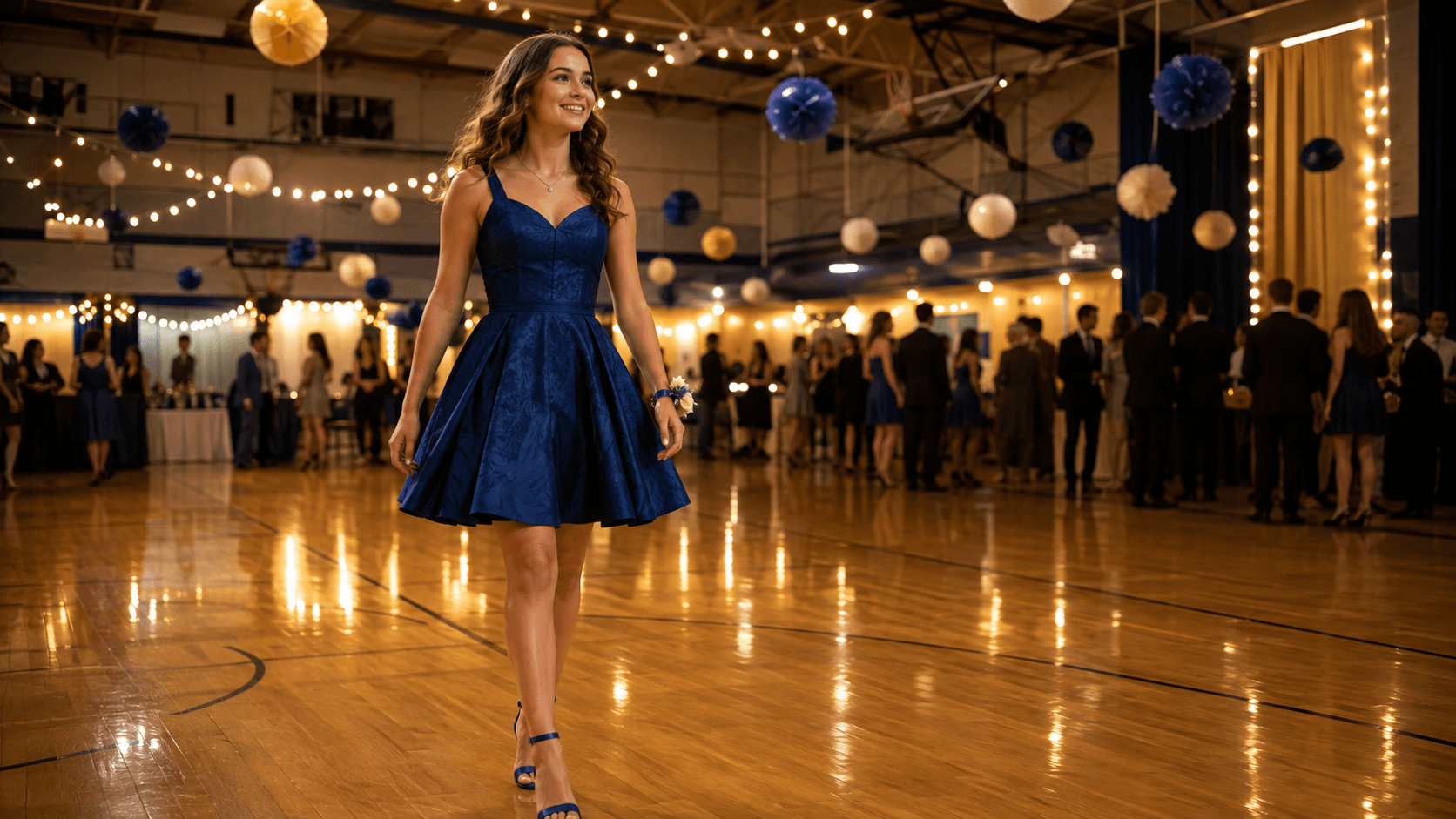
Prom and homecoming shoppers should order early enough to test the actual dress, not merely trust the size chart. Our homecoming dress test can help you check light, movement, and confidence before the event. For a made-to-order prom look, custom prom dress planning starts with the same priorities: deadline, support, coverage, movement, and a realistic fitting plan.
Put “stays up while dancing” into the design brief
“Strapless teal gown” describes an appearance.
It does not describe performance.
A useful custom brief names both:
Design a floor-length deep-teal strapless formal gown with a secure, opaque bodice for several hours of sitting and dancing. I need comfortable support through the torso, a defined natural waist, and a neckline that stays in position when I raise both arms. Please explain the proposed boning, cups, inner foundation or waist stay, back closure, lining, and skirt weight. Include removable straps only as an agreed backup, not as the main support plan.
Add your measurements, event date, preferred coverage, undergarment plan, and any sensitivity to pressure or adhesives. Ask what will be verified before production and what a local tailor may still need to adjust.
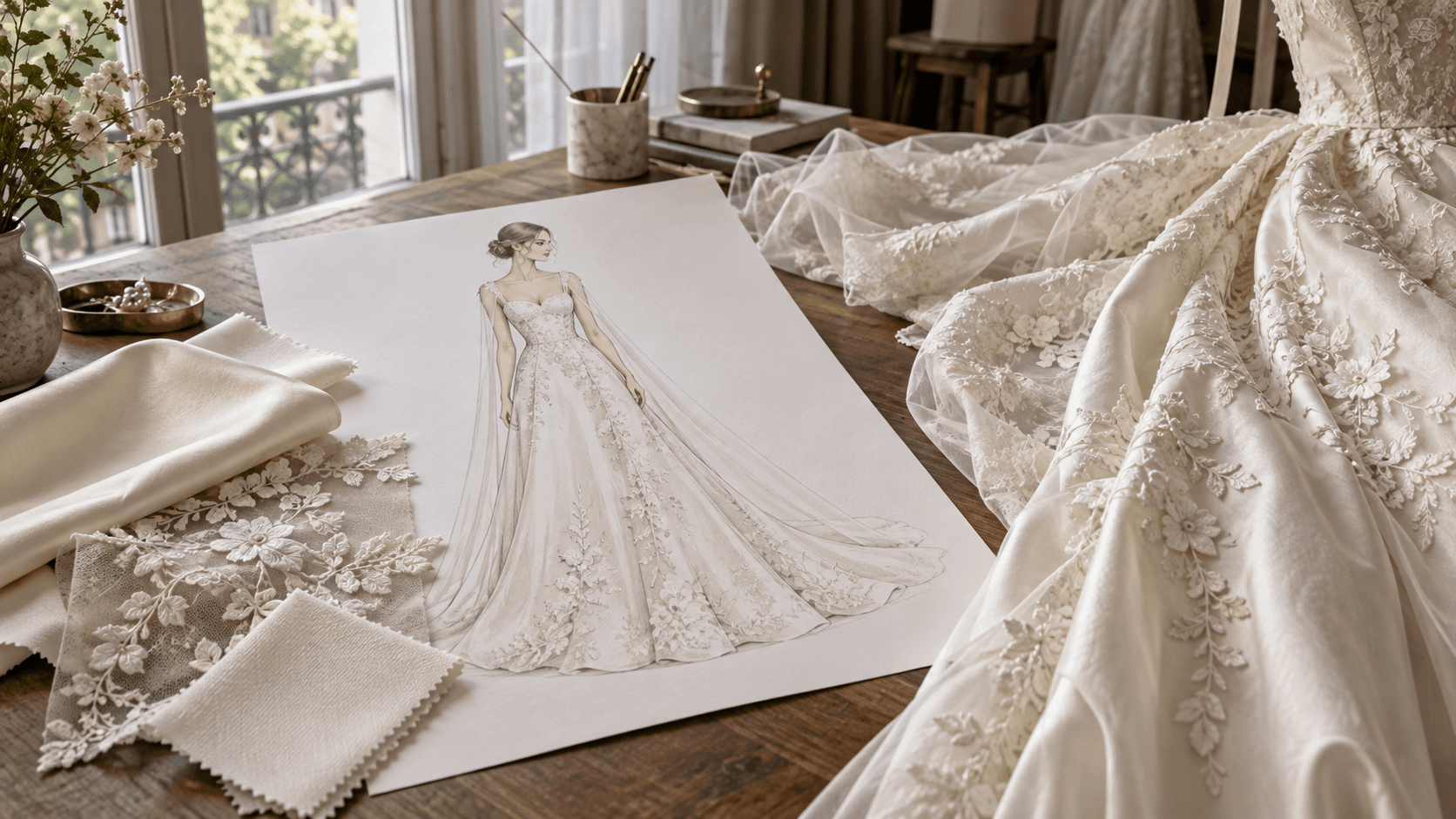
You can upload a strapless-dress reference or start from a written dress idea to explore the silhouette. A generated design image is a visual reference, not a sewing pattern or proof of fit, so keep the construction questions in the conversation.
The beautiful part of a custom brief is not the color adjective.
It is the sentence that tells the dress what your night will demand.
Give the dress seven honest minutes
Return to 8:14 P.M.
The song starts. You lift both arms.
This time, nothing moves except you.
That confidence does not come from hoping the tape is strong enough. It comes from learning what holds a strapless dress up, testing the actual gown, and fixing the correct problem before the event.
Fit first. Structure second. Tape last.
Seven honest minutes in your room can buy you an entire night with both hands free.