Wedding Dress Sample Sale: The Bargain Can Disappear Before You Wear It
Before buying a wedding dress sample, check its condition, achievable fit, alteration timeline, and total cost. Take this practical checklist to the sale.
Wedding dress sample sale: the bargain can disappear before you wear it
The stylist turns the tag over.
You have already noticed the neckline. The weight of the skirt. The way your friend stopped talking when you stepped out of the fitting room. Now there is a second reason to love the dress: the price has dropped into a world you can actually afford.
Someone else has an appointment after yours.
Suddenly, taking ten minutes to think feels strangely reckless.
At a wedding dress sample sale, those ten minutes belong in the purchase. Before paying, inspect the actual gown, get a realistic assessment of the changes it needs, confirm the schedule and sale terms, and calculate the cost of wearing it finished. A beautiful discount is useful only when the dress works for your body, your plans, and your budget.
You can leave with a wonderful find. You can also leave with an expensive project you mistook for a finished outfit.
Here is how to tell the difference while the decision is still yours.
The dress on the hanger is the dress you are buying
A sample gown is usually a boutique's try-on dress. At a sample sale, you are generally buying that existing garment, with its existing size and condition, rather than ordering another one made for you.
An off-the-rack wedding dress can also be unworn stock. Ask which you are looking at; the labels are sometimes used loosely.
David's Bridal's sample-sale shopping guide describes these purchases as commonly sold as-is and final sale. Its useful reminder is to confirm the individual store's policy before committing. A discount does not tell you what work is included.
Start with one plain question:
“Am I taking home this exact dress, and what will you do to it before collection?”
Then establish what comes with it. Are the sleeves on the rail included? Is the belt part of the gown or a separate accessory? Are you looking at the original straps, or temporary ones added for the appointment?
Take photographs with permission. Ask for the designer, style identifier, labeled size, color, and included pieces on the purchase paperwork. Your notes should describe the garment you chose, not just the collection photograph that first attracted you.
A lower price can make a different dress seem like your dress
There is a quiet difference between loving a gown and loving what you could turn it into.
In an October 2026 wedding dress discussion, a shopper described buying a discounted sample with plans to add draping, then questioning the choice after trying another silhouette. One person's experience cannot predict yours. It does reveal a useful question to ask before the sale: how much of your excitement depends on a version that does not exist yet?
Write two separate lists:
- What I love now: the actual neckline, skirt shape, fabric, or feeling of wearing it.
- What must change: the fit, support, coverage, length, or design details you need before you would feel happy wearing it.
The second list is your purchasing homework.
If every feature you love requires reconstruction, compare other dresses before committing. If you love the existing design and need a clearly assessed fit adjustment, you have a much simpler decision.
This is also a good moment to hide the original price. Imagine seeing only today's total. Would you still choose the dress?
If the appointment itself has become overwhelming, our wedding dress shopping reset can help you separate your preferences from the pressure to finish.
“It can be altered” needs a person, a plan, and a price
A clipped fitting-room silhouette is a proposal. Ask an experienced bridal alterations specialist whether that proposal can become the finished garment you want.
Avoid buying on a universal rule about how many sizes a dress can go up or down. The useful answer concerns this gown, its construction, and your measurements. A size label cannot give you that answer.
Ask the specialist to explain three things:
- The change: What exactly needs adjusting, and what result can reasonably be achieved?
- The consequence: Could that change affect another part of the design, such as the neckline, strap position, or decorative layout?
- The commitment: What is the estimated cost, what remains uncertain, and when can the work be completed?
If the person selling the gown will not perform the alterations, find out who will. An enthusiastic suggestion from a stylist is different from an assessment by the person taking responsibility for the work.
Try the gown with the support and shoe height you realistically expect to wear. Tell the fitter about any non-negotiable coverage or movement needs. Buy for your present body; a deadline for changing yourself is a poor substitute for a fit plan.
For a remote purchase, request current photographs of the actual gown and the seller's garment measurements, including how they were taken. Send that information to your alterations specialist before payment. A stock photograph cannot establish the condition or remaining alteration options of a particular sample.
If no one can assess a necessary change before the sale ends, record it as an unanswered question. Do not turn it into a promise just because the dress might sell.
Inspect the parts the flattering photograph leaves out
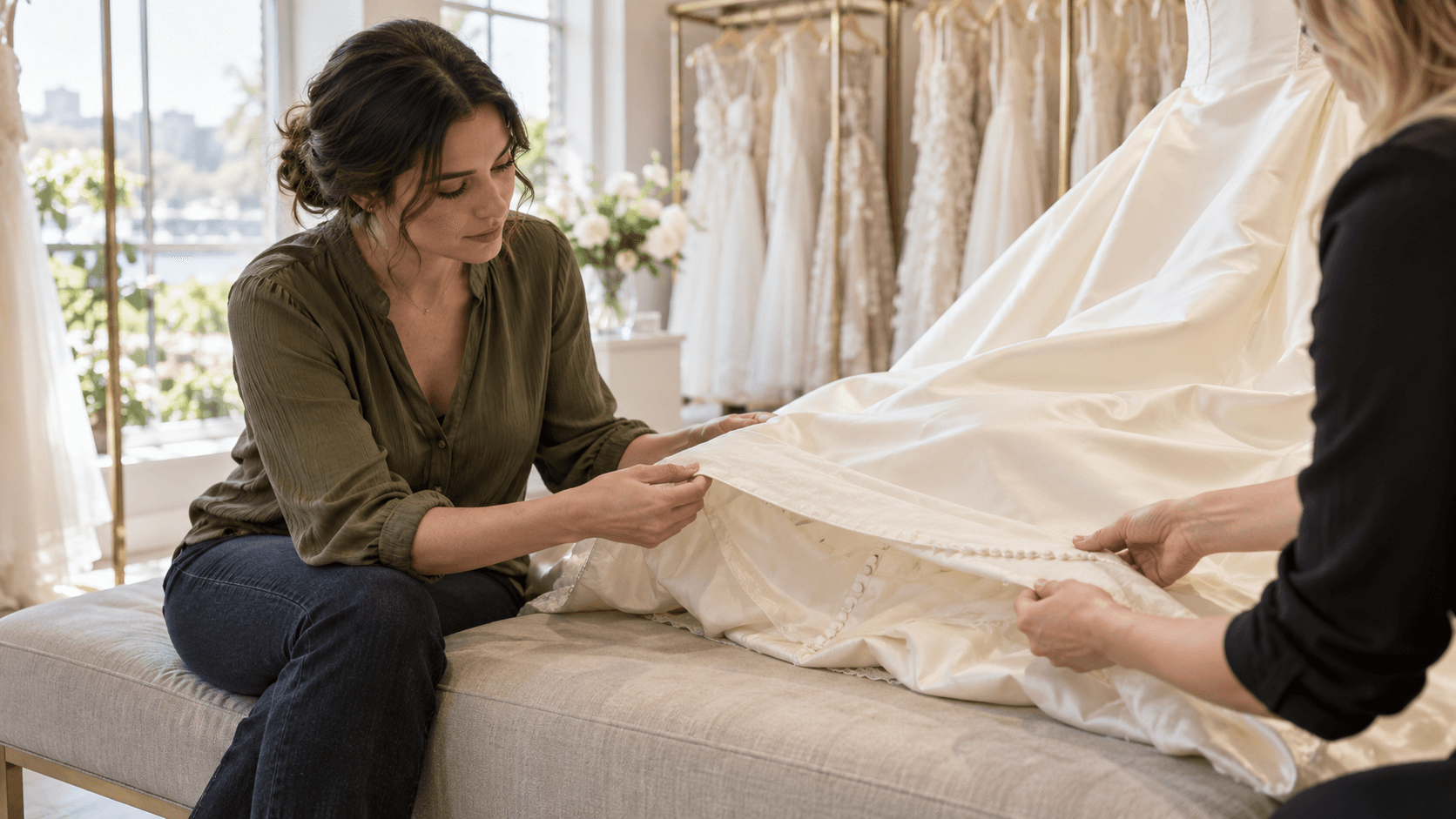
Ask the shop to show you the gown in clear light, outside its garment bag. Let the stylist handle delicate areas and demonstrate the closures; do not pull at embellishments or force a reluctant zipper.
Work through the dress in an order you can remember: outside, inside, included pieces.
On the outside, look for visible marks, uneven color, tears, missing decoration, and wear around the lower skirt or train. Inside, ask to see the lining and the areas that hold the dress on the body. Check that the supplied detachable pieces match and attach as intended.
You are collecting information, not diagnosing repairs yourself.
For every issue, ask whether you would accept it unchanged. If the answer is no, the repair becomes a condition of your decision. Have the relevant professional assess it, including whether the desired result is uncertain.
“That should clean out” is not the same as a cleaner evaluating the fabric and mark. “We can find another button” leaves open whether the replacement will match. A small imperfection can be entirely acceptable when you have seen it and chosen it knowingly.
Keep a short condition record with photographs and the shop's written description of any work it agrees to complete. Before collection, compare the gown with that record.
Calculate the number that never appears on the sale tag
The useful comparison is between outfits you can actually wear to your wedding.
Use this working total:
Gown + tax and delivery + assessed alterations + necessary cleaning or repairs + required missing pieces = expected finished cost.
Keep optional styling changes on a separate line. A veil you would buy with any dress should not make one option look uniquely expensive. A replacement component needed only for this sample should be part of its comparison.
For illustration, imagine a sample priced at $800. Add a $650 alteration estimate, $180 for assessed cleaning and repairs, $90 for a necessary replacement piece, and $80 in tax and delivery. The expected total is $1,800. Those are invented planning figures, not market rates or a quote.
Now imagine another dress priced at $1,250, with $300 in alterations and $100 in tax and delivery: $1,650 finished. The first dress has the lower tag. The second has the lower estimated total.
Either could still be your favorite. The calculation gives you a fair comparison.
For a broader breakdown of which tasks belong in an estimate, use our wedding dress alterations cost guide, then obtain a quote for your actual garment. Add a contingency you can afford for unresolved work; if an essential change has no credible estimate, the total is not ready yet.
Taking it home today does not mean it is ready today
Buying an available gown removes an ordering wait. It does not reserve time with an alterations specialist or cleaner.
Before paying, work backward from the date you need the finished dress in your hands. That may be your departure date rather than your wedding date.
Confirm the first fitting, any intermediate visits, final fitting, and collection. Ask whether cleaning must happen before or after particular alterations, and who will coordinate the sequence. If a component must be sourced, include that wait too.
A rush fee can change the cost. A fully booked specialist can change whether the plan is possible at all.
Use our final wedding dress fitting checklist later, when the work is complete. At the sale, your job is to establish that there is enough time to reach that final appointment.
Put the unanswered questions on the receipt side of the decision
Before payment, ask the retailer to explain its cancellation, return, exchange, and hold policies for this specific purchase. Have the applicable terms and any promised work written down. Policies differ; do not assume a regular-stock policy applies to sale samples.
If you need time for an independent assessment, ask whether a hold is available and whether any deposit is refundable. Confirm the amount, deadline, and terms before paying it.
The shop may say no. That gives you a real choice: accept the known uncertainty or leave the gown.
Walking away can feel worse than buying in the moment. It can also be the most useful decision of the appointment.
If the sample helped you identify a neckline or silhouette you love, keep those discoveries. You can upload your dress inspiration or explore a dress design to clarify the features you want. A design concept still needs its own construction, pricing, and timeline assessment before you commit to having it made.
Save this before you enter the sale
Complete these six lines on your phone:
- Exact gown: designer, style, size, color, and included pieces.
- Condition accepted: photographed issues and any agreed work.
- Fit confirmed: named specialist, feasible changes, and remaining uncertainties.
- Finished cost: expected total, optional changes, and contingency.
- Calendar confirmed: fittings, cleaning sequence, and collection before travel.
- Terms understood: sale policy, deposit or hold terms, and written promises.
An empty line is a question to answer before payment.
When all six make sense, enjoy the find. There is real pleasure in choosing a beautiful gown you can afford and carrying it home without months of waiting.
Let the saving be part of that pleasure. Let the dress itself earn the yes.