
Wedding Dress Shopping Overwhelmed? Stop Before You Try On Another Gown
Wedding dress shopping overwhelmed you? Use this three-gown reset to identify your real style, compare dresses clearly, and choose without panic.
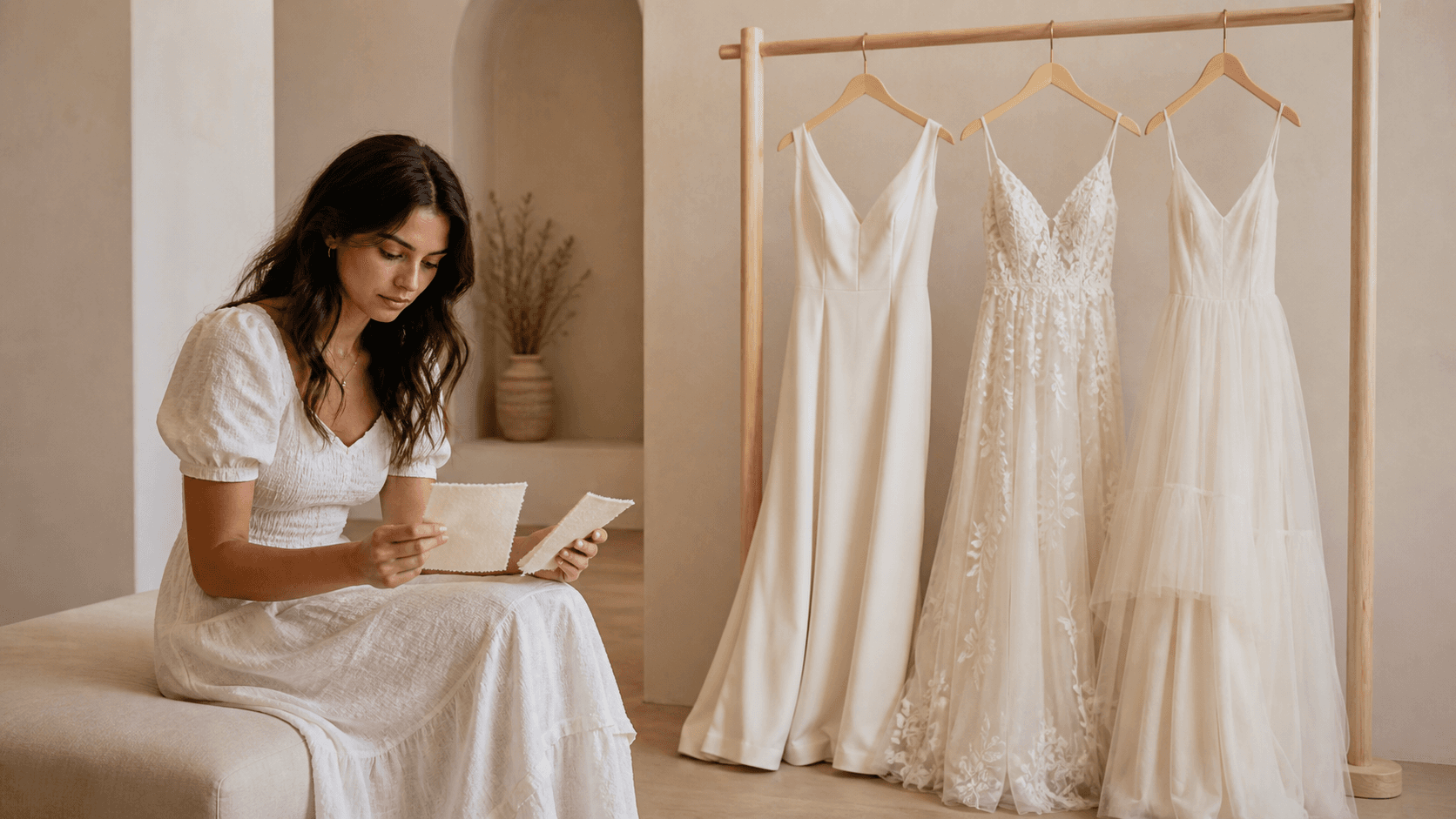
Wedding dress shopping overwhelmed? Stop before you try on another gown
The stylist closes the zipper.
Your mother leans forward. Your friend lifts the phone. Somewhere behind you, another bride's room erupts in applause.
You face the mirror in the fourth beautiful white dress of the afternoon and feel absolutely nothing.
Not dislike. Not delight.
Just static.
Meanwhile, your camera roll contains 486 saved gowns. You can identify a basque waist at ten paces. You know the difference between mikado and satin. Yet the moment a real dress is on your body, every opinion you thought you had disappears.
If wedding dress shopping overwhelmed you this way, the answer is probably not another boutique, another hundred screenshots, or another rapid-fire rack of samples.
You do not need more options. You need cleaner comparisons.
The three-gown reset below turns an appointment from a search for a mythical feeling into a small, useful experiment. You will try one familiar gown, one deliberate contrast, and one bridge between them. Then you will leave with evidence—even if you do not leave with a dress.
That is how you learn what your wedding dress style actually is.
You are not failing the “say yes” moment
In an August 2026 wedding-dress discussion, a bride described reaching her fourth appointment and still not knowing what she liked. Gowns appealed to her on the hanger, then felt completely different on her body.
That gap is normal. A saved image shows one dress, on one person, from a controlled angle, in finished styling. A bridal appointment adds a sample size, temporary clips, unfamiliar lighting, an audience, a deadline, and your own reflection.
Those are not equivalent experiences.
A current no-nonsense bridal shopping guide makes a similar point: social feeds and cinematic expectations can make the real fitting room feel surprisingly noisy and unromantic. Sometimes a good decision arrives as calm recognition, not tears.
The pressure to manufacture a movie moment creates a bad test. “Is this the one?” is so large that almost any honest answer will be uncertainty.
Ask smaller questions.
Did I like where the waist sat? Did I stand differently in structure or softness? Did I want more volume—or did I only like the photograph of volume? Could I sit, breathe, and raise my arms? Did I look like myself?
Small answers build a trustworthy decision.
Your mood board gave you a fantasy, not a priority list
Pinterest is excellent at collecting atmosphere.
It is less useful at resolving conflict.
Your board may contain a clean silk column because you love its restraint, a floral tulle ball gown because you love its romance, a corset gown because you love its shape, and a long-sleeved lace dress because you love how protected it feels. The images seem contradictory only if you treat each gown as a complete instruction.
Look again. Each image may be carrying one job.
- The column is telling you that you like visual quiet.
- The ball gown is telling you that you want movement.
- The corset is telling you that support matters.
- The sleeves are telling you that coverage makes you feel composed.
This is the curiosity gap hiding inside “I like everything.”
You may not like everything. You may like four separate qualities that retail dresses keep presenting in different combinations.
Before your next appointment, reduce your inspiration to five images. Under each one, finish this sentence: I saved this because…
You cannot write “the vibe.” Name the element: neckline, waist placement, surface detail, volume, fabric behavior, coverage, support, or movement.
Now you have a brief.
The three-gown reset that cuts through the noise
This is not a rule about the only three wedding dresses you should ever try. It is a reset for the point when more dresses are producing less information.
Tell the stylist you want to compare three directions slowly. Ask them to avoid bringing a fourth dress until you have recorded what each of the first three taught you.
Gown one: the familiar
Start with the dress closest to how you already like to look.
Not the most bridal. Not the gown your venue appears to demand. Choose the one that connects to clothes you have genuinely enjoyed wearing: a defined waist, an open neckline, clean tailoring, soft sleeves, a fitted shape, or easy movement.
This establishes your baseline.
The familiar gown may not be dramatic enough. That is useful. You are learning which part of your everyday identity needs to remain visible when the dress becomes bridal.
Ask:
- What feels immediately like me?
- What feels too ordinary for the occasion?
- Which proportion do I want to keep?
Gown two: the deliberate contrast
Now change one major variable.
If the first gown was soft, try structure. If it was narrow, try volume. If it was ornate, try a clean surface. If it was covered, try a more open neckline that still feels secure.
Do not change everything at once. A strapless beaded ball gown and a long-sleeved crepe column teach you very little about which difference caused your reaction.
The point of contrast is not to shock you into a surprise purchase. It is to make your preference visible.
Ask:
- Did the changed element give me energy or make me disappear?
- Is my reaction about the design, or about unfamiliarity?
- Which detail from gown one do I miss?
Gown three: the bridge
The bridge combines the strongest signal from each dress.
Maybe you liked the ease of the familiar A-line but the clean surface of the structured contrast. Maybe you loved the corset's support but wanted the first gown's softer skirt. Maybe the contrast proved that you do want drama—just not at the neckline.
Ask the stylist for the closest available combination.
This third gown is where a vague taste begins to become a design direction. It may be the dress. More often, it gives you a precise sentence:
I want the support and waist definition of gown two, with the quieter fabric and movement of gown one.
That sentence is worth more than another fifty saves.
Do not judge a wedding dress while standing still
The mirror gives one answer. Your wedding day will ask twenty other questions.
Walk the length of the fitting room. Sit down. Turn quickly. Lift both arms. Take three deep breaths. Look down at the dress without using the mirror. If the salon permits photos, record a short front, side, back, and movement video at a consistent distance.
Then notice what your body does.
Are you constantly pulling the neckline up? Are you holding your shoulders in a way you cannot sustain? Does the skirt make you want to move, or are you managing it? Do you keep touching one detail because you love it—or because you are trying to fix it?
Comfort does not mean the dress must feel like pajamas. It means the gown's structure is doing its job without requiring you to supervise it every minute.
Also ask the stylist what you are actually seeing:
- Where is the sample clipped, and how does that change the waist or neckline?
- How will the ordered size differ from this sample?
- Is the bodice designed to support you, or is the sample merely pinned tightly?
- Which changes are normal fitting work, and which would require redesign?
If a gown is promising only because of aggressive clipping, price the path from sample fantasy to finished fit. Our wedding dress alterations cost guide explains why seemingly small changes can become complex once boning, seams, lace, and lining are involved.
Turn every “almost” dress into evidence
An almost-right dress is not wasted time.
It is a prototype.
Before taking it off, complete three lines:
- Keep: the one element you would carry into the next gown.
- Change: the one element preventing a yes.
- Test: the exact comparison you need next.
For example:
- Keep: the low basque waist.
- Change: the heavy floral appliqué.
- Test: the same waist in smooth satin or matte crepe.
Or:
- Keep: the soft A-line movement.
- Change: the loose bust support.
- Test: the same skirt feeling with an internally structured bodice.
This language protects you from the most expensive kind of overwhelm: solving the wrong problem.
If you say “I need something more special,” a salesperson can bring almost anything. If you say “I want this clean neckline with more movement below the hip,” the next dress has a job.
Five phrases that reveal what is really blocking you
Listen to the sentence you repeat in the fitting room. It often tells you which problem you are trying to solve.
“It is beautiful, but it is not me”
The dress may match your wedding aesthetic better than your personal style. Return to the familiar gown and name what made you recognizable there.
“I only like it from this angle”
This may be fit, proportion, or styling rather than a complete design failure. Ask what temporary clipping is changing and view the gown in motion before deciding.
“Everyone loves it”
That is information about the room, not about you. Ask for two private minutes with the mirror. Notice whether you feel relieved or disappointed when nobody is reacting.
“I just need to try more”
Name the missing category first. If you cannot identify what the next dress needs to test, more options may only restart the loop.
“I wish it had this top and that skirt”
You may not have a taste problem. You may have a combination problem.
Save the two references and turn the difference into a clear brief. You can upload wedding dress inspiration to compare a combined direction, or start a wedding dress concept from your own description before asking another boutique to guess what you mean.
How to choose a wedding dress without polling the room
An entourage can notice things you miss. It can also turn one decision into five competing biographies of you.
Choose one or two people who can separate their taste from yours. Before the appointment, tell them what kind of feedback helps.
Useful feedback sounds like:
- “You relaxed when you put this one on.”
- “You have adjusted that strap three times.”
- “This is the waist placement you kept saving.”
Unhelpful feedback sounds like:
- “I would wear the other one.”
- “This venue needs more sparkle.”
- “You do not look bridal enough.”
Give your own reaction before anyone else speaks. If every face in the room reacts first, you will spend the appointment interpreting them instead of the dress.
And do not outsource the final vote to a group chat. A still image rewards drama, contrast, and photogenic detail. It cannot report how supported, mobile, exposed, or recognizable you felt.
Know when to leave the appointment
Decision fatigue can make the sixth gown look dull simply because you are tired. It can also make the twelfth gown feel urgent because you want the day to end.
Set an appointment stop rule before shopping. For example:
- three diagnostic gowns, then a short break;
- no purchase after the point when every reaction becomes “I don't know”;
- no same-day decision if the contract allows a hold and pressure is rising;
- no second boutique on the same day unless you still feel curious rather than depleted.
If a dress meets your non-negotiables and you cannot name a specific flaw, you may be waiting for certainty no garment can provide. If you can name the flaw, protect your options and investigate it.
Those are different states.
The wedding dress regret test is useful if you have already paid and the doubt arrived later. Before purchase, your goal is simpler: gather enough specific evidence that your yes belongs to you.
What if no wedding dress feels right after the reset?
Stop treating that result as a verdict on your body or your ability to choose.
One of these may be true:
- The available samples cannot approximate the fit or support you need.
- The silhouettes you like are outside that boutique's inventory or your current price range.
- Your brief contains qualities that are rarely sold together.
- The people, pace, or fitting environment are drowning out your reactions.
- You need a body-image break, food, water, rest, or a lower-pressure appointment.
- You like the idea in your inspiration images but not the real-life fabric, volume, or exposure.
Each answer suggests a different next step. Change the shop, the appointment conditions, the construction requirement, the budget, or the design direction—but change one thing at a time.
If your brief consistently sounds like “this bodice, that skirt, less lace, more support,” a custom direction may be more honest than trying to fall in love with an off-the-rack compromise. Exploring a concept does not commit you to production. It simply makes the combination visible enough to evaluate.
Frequently asked questions about overwhelmed wedding dress shopping
How many wedding dresses should I try on?
There is no ideal number. The useful measure is whether each gown answers a new question. If the dresses blur together, pause and review your keep, change, and test notes before adding more options.
What if I do not know what wedding dress style suits me?
Start with qualities rather than body-type rules. Compare familiar versus contrasting structure, volume, surface detail, coverage, and movement. The goal is not to discover what your body is “allowed” to wear. It is to identify the combination that supports you and still feels recognizable.
Should I buy a wedding dress if I do not cry?
Tears are not a fit criterion. A strong yes may feel excited, peaceful, relieved, or simply clear. Focus on whether the dress meets your practical needs, reflects your taste, and leaves you without a specific unresolved concern.
Can I combine details from different wedding dresses?
Often, yes, through custom design or carefully scoped alterations. Feasibility depends on the pattern, fabric, support structure, seams, and timeline. Visualize the combination first, then ask a qualified designer or bridal tailor what can be constructed cleanly.
How do I stop overthinking my wedding dress?
Stop collecting new inspiration for a few days, reduce your brief to three non-negotiables, and run one controlled comparison. Overthinking thrives on vague criteria and unlimited options. Specific tests give the decision an end point.
You do not need to find yourself in a dress
The fitting room has been asking the wrong question.
It keeps asking which gown can transform you into a bride.
Try this instead: which gown lets you remain yourself while the day becomes extraordinary?
Start with the familiar. Test the contrast. Build the bridge. Keep one thing, change one thing, and know what you are testing next.
The goal is not to make every beautiful dress disappear.
It is to make your own preference loud enough to hear.

