Maternity Wedding Guest Dresses: Why ‘Just Size Up’ Can Be an Expensive Mistake
Shopping for maternity wedding guest dresses? Check the event date, bump room, lining, and seated fit before sizing up or buying a dress you cannot return.
Maternity wedding guest dresses: why ‘just size up’ can be an expensive mistake
The parcel is open on the bed. The dress is the right color. The wedding is three weeks away.
You ordered the bigger size, exactly as the reviews suggested.
Now the shoulders slide. The neckline gapes. And somehow, after all that extra fabric, the seam across your bump still feels wrong when you sit down.
That is the problem with treating pregnancy as a single larger dress size.
When shopping for maternity wedding guest dresses, start with the wedding date, the brand's sizing instructions, and the garment's actual construction. A maternity cut can put room where you need it. A regular dress can also work if its shape, lining, and movement genuinely accommodate you. Neither label replaces a try-on.
The useful question is not simply whether you can zip it up today.
It is whether you have a realistic plan for wearing it comfortably on the day you were invited to celebrate.
The wedding date belongs beside the size chart
It is surprisingly easy to shop for the person standing in front of the mirror and forget the date on the invitation.
In a November discussion about outgrowing formal clothes before a wedding, a guest who was five months pregnant described discovering that her usual options no longer fit. A velvet wrap dress still worked, but she was unsure whether it was formal enough. Even during her third pregnancy, the change had arrived faster than she anticipated.
That distinction matters more than another hour of scrolling.
Write down four things before you order:
- The event date and the dress code as written.
- How far away the event is from today's fitting.
- The delivery estimate and the last date for an eligible return or exchange.
- When you will try the complete outfit again before leaving.
There is no reliable formula that converts a number of weeks into a number of dress sizes. Two people at the same stage can need very different fits. Even your experience with a previous pregnancy may not predict this dress.
If the wedding is months away, research styles and ask about lead times now. Avoid treating a rigid, final-sale dress that only just fits as a solved problem.
If it is next weekend, prioritize something you can actually receive, try, and replace in time. A beautiful delivery estimate is still only an estimate.
A bigger regular dress adds room in places you may not need
Sizing up a regular dress generally changes more than the belly area. Depending on the pattern, you may also gain width through the shoulders, bust, armholes, and back.
Sometimes that is exactly what you need. Sometimes it creates a loose top attached to a skirt that still pulls across the front.
A maternity design may use extra front length, gathering, stretch, adjustable details, or a seam positioned above the bump. Inspect the particular dress rather than assuming every maternity garment has every feature.
Brand instructions also differ. For example, Nordstrom's listing for a Seraphine ruched maternity dress says to order your pre-pregnancy size. That is guidance for that product, not a universal rule for everything with a maternity label.
Read the size guide and fit notes together. If the brand asks for current measurements, follow its measuring method. If it starts from your pre-pregnancy size, use that instruction and ask customer service how to handle measurements that fall outside the chart.
“I always buy a medium” is background information. It is not a fit assessment.
For a regular dress, check whether the smallest comfortable size also sits correctly at the shoulders and neckline. If you need substantial alterations above the bump just to gain room below it, compare that total cost with a different cut before buying.
“Bump friendly” describes a possibility, not a promise
The phrase is helpful for finding ideas. It does not tell you how the dress is built.
A flowing skirt can hide a narrow lining. A stretchy outer layer can have a fixed waist seam. A wrap effect can be stitched shut.
Look for the detail that actually provides room.
An empire seam needs to sit where you find it comfortable
A raised seam can let the skirt fall freely from below the bust. But the bodice still has to accommodate your bust, and the seam still has to feel comfortable while seated.
If it presses or rides up, the word empire does not rescue it. Try another bodice length or construction.
A wrap dress needs enough overlap to move with you
Check whether it is a true adjustable wrap or a fixed crossover design. Sit, turn, and walk. Notice whether the neckline opens or the skirt overlap becomes too narrow for your comfort.
Choose a dress that works with your preferred coverage without constant holding, tugging, or an improvised repair at the venue.
Stretch only helps where the whole garment can stretch
Gently check the outer fabric and lining according to the garment's care and handling guidance. A flexible shell over a restrictive lining can still feel tight.
Also look in ordinary daylight. Fabric stretched beyond its comfortable fit may reveal more than you expected. Our guide to underlayers and dress opacity can help you check coverage with the actual undergarments you plan to wear.
A loose silhouette still needs enough length in front
The fabric has to travel over the bump before it reaches the hem. Check the front and side view instead of trusting the model's photographed length.
You do not need to dislike a shorter front hem. You do need to know it is there before ordering shoes or arranging alterations.
Formality comes from the whole dress, not how tightly it fits
A formal maternity wedding guest dress can have a fluid silhouette. It does not have to squeeze you to look intentional.
Use the invitation to narrow the category first. Then assess fabric, finish, length, and the overall styling within that category.
For cocktail attire, a polished knee-length or midi dress may be a useful starting point. For black tie, look at evening gowns or another clearly formal option that fits the host's expectations. If the wording is unclear, ask whether the hosts expect floor-length gowns or also welcome dressy shorter styles.
Our cocktail attire guide and black-tie-optional guide explain those categories in more detail.
Avoid making the entire decision about whether strangers will give a pregnant guest a pass. You can ask for clarity, choose comfort, and still enjoy dressing for the occasion.
You are attending a celebration. You are not auditioning for permission to have a changing body.
The seated try-on reveals what the mirror misses
Keep the tags attached and follow the seller's return conditions while assessing a new dress. Try it indoors with the bra, underwear, shoes, and outer layer you intend to use.
Then move through the parts of an ordinary wedding day.
- Stand naturally. Let your shoulders relax. Check whether the bodice sits in place without holding a pose.
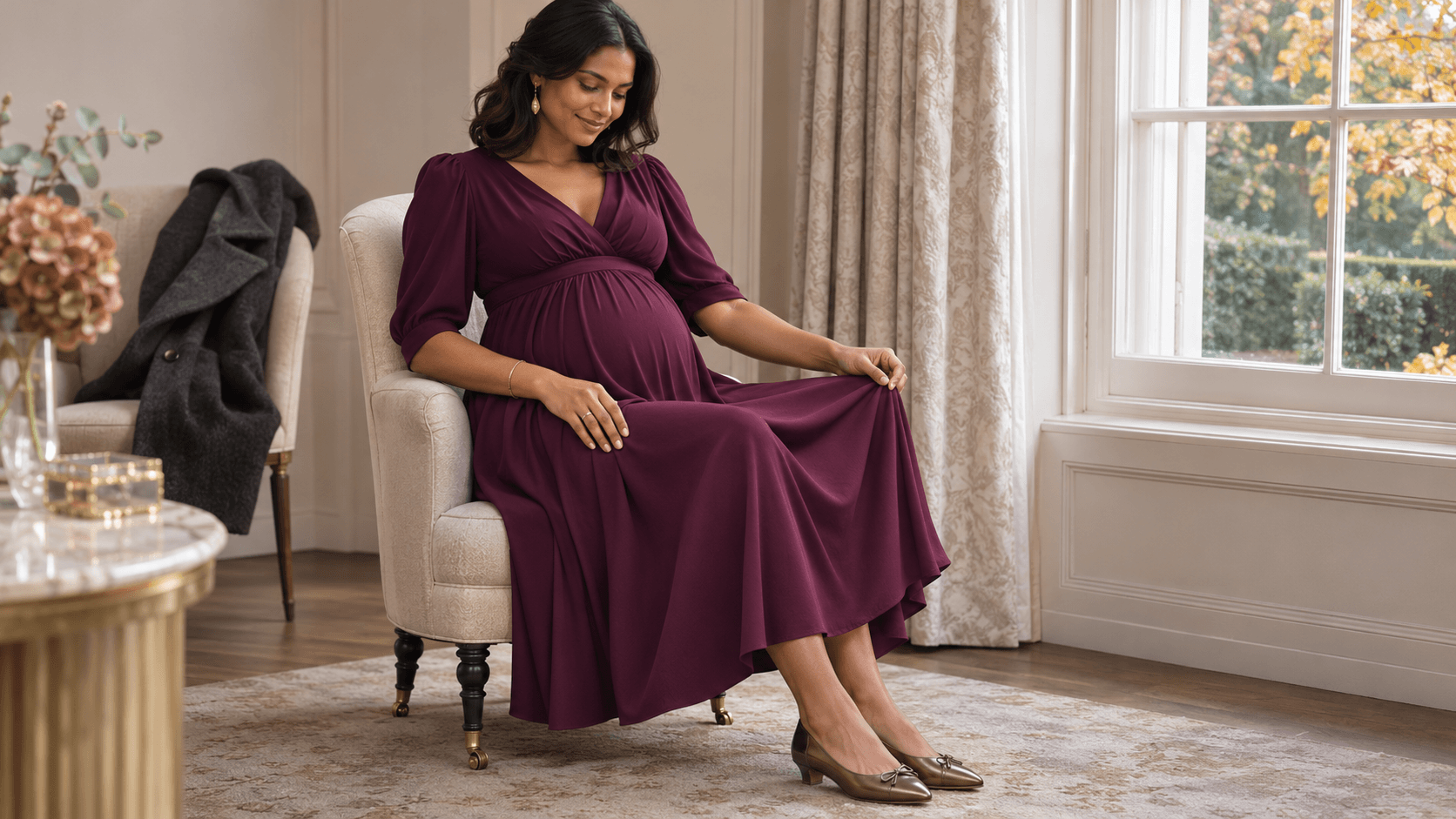
- Sit in a normal chair. Notice pressure at the underbust seam, bump, hips, and arms. Check the neckline and skirt coverage from a seated position.
- Stand up and walk. See whether the skirt settles again or needs repeated rearranging. Check stairs if they are part of your venue and you can comfortably try them.
- Reach for a bag or put on your coat. Notice whether the sleeves pull or the neckline shifts.
- Check the complete outfit in daylight. Look at opacity, visible underlayers, front hem length, and shoe clearance.
Treat persistent pressure, pulling, or constant adjustment as reasons to reconsider the garment. A dress that requires you to tolerate discomfort during a short fitting has not earned a long reception.
If the event is still some time away, repeat the try-on closer to the date. Today's success cannot guarantee future fit.
The coat deserves its own check, especially for winter weddings. A layer that no longer closes comfortably is not much help during an outdoor wait. Our formal-dress outerwear guide covers the practical details beyond choosing a pretty wrap.
The cheapest dress can come with the most expensive rescue plan
A discounted dress is tempting when you expect to wear it once.
Before paying, add the things needed to make it usable: alterations, different underlayers, shipping, and any backup you would need if the fit changes. Check the actual refund terms, including whether a sale item is exchange-only or final sale.
You are comparing complete options, not just two prices on product pages.
Borrowing can work well if you can try the exact dress. Resale can give you more choice, but ask about alterations and the seller's measurements rather than relying on the original size label. For rental, check arrival timing, fit alternatives, and return deadlines before committing.
None of those routes is automatically cheaper once the whole plan is counted.
If a tailor's help is part of the plan, ask them to assess the specific garment before assuming it can be let out or reshaped. Tell them the event date and that your measurements may change. The available seam allowance and construction determine what is possible.
Buying a dress because someone might be able to fix it later leaves the hardest decision until after you have paid.
A custom brief needs a changing-fit plan, too
Custom design can help you describe the neckline, sleeves, skirt shape, and coverage you want. It does not remove the uncertainty of future measurements.
If you explore a custom option, ask the maker when measurements are needed, what adjustments the design allows, whether a later fitting is possible, and how delivery timing relates to your event. Get those answers before committing to production.
You can start a dress concept or upload an inspiration image to explain the visual direction. Include the event date and your fit priorities in the brief. A generated image can communicate a silhouette; it cannot verify seated comfort, fabric behavior, or future fit.
The useful brief is specific: “I want this soft skirt and these sleeves, with comfortable room through the front, coverage while seated, and a measurement schedule we have agreed.”
That gives a maker something concrete to discuss.
Keep this checklist open before you buy
You do not need twenty promising dresses. You need a manageable choice with answers to these questions:
- Date: Am I choosing for the wedding date, with time to try and replace the dress?
- Sizing: Have I followed this brand's instructions rather than automatically adding sizes?
- Construction: Where does the room come from, and does the lining allow it too?
- Movement: Can I sit, walk, and reach without pressure or constant adjustment?
- Outfit: Do the shoes, underlayers, hem, and coat work together?
- Exit plan: If the fit is wrong, can I return, exchange, or use a realistic alternative?
If one answer is missing, resolve it before letting a discount or a nearly sold-out label make the decision.
The right dress might be maternity. It might already be in your wardrobe. It might be a regular style whose shape happens to work beautifully for you.
What matters is that you can sit down at dinner, turn toward someone you love, and forget about the seam you were worried about.
That is a much better purchase than a larger number on a label.