The $16,000 Wedding Dress and the Question Every Bride Is Afraid to Ask
A news-tied editorial on bridal sticker shock, fashion fantasy, and how brides can reclaim meaning without surrendering their budget.

The $16,000 wedding dress and the question every bride is afraid to ask
There is a particular silence that happens when a bride falls in love with a dress she cannot afford.
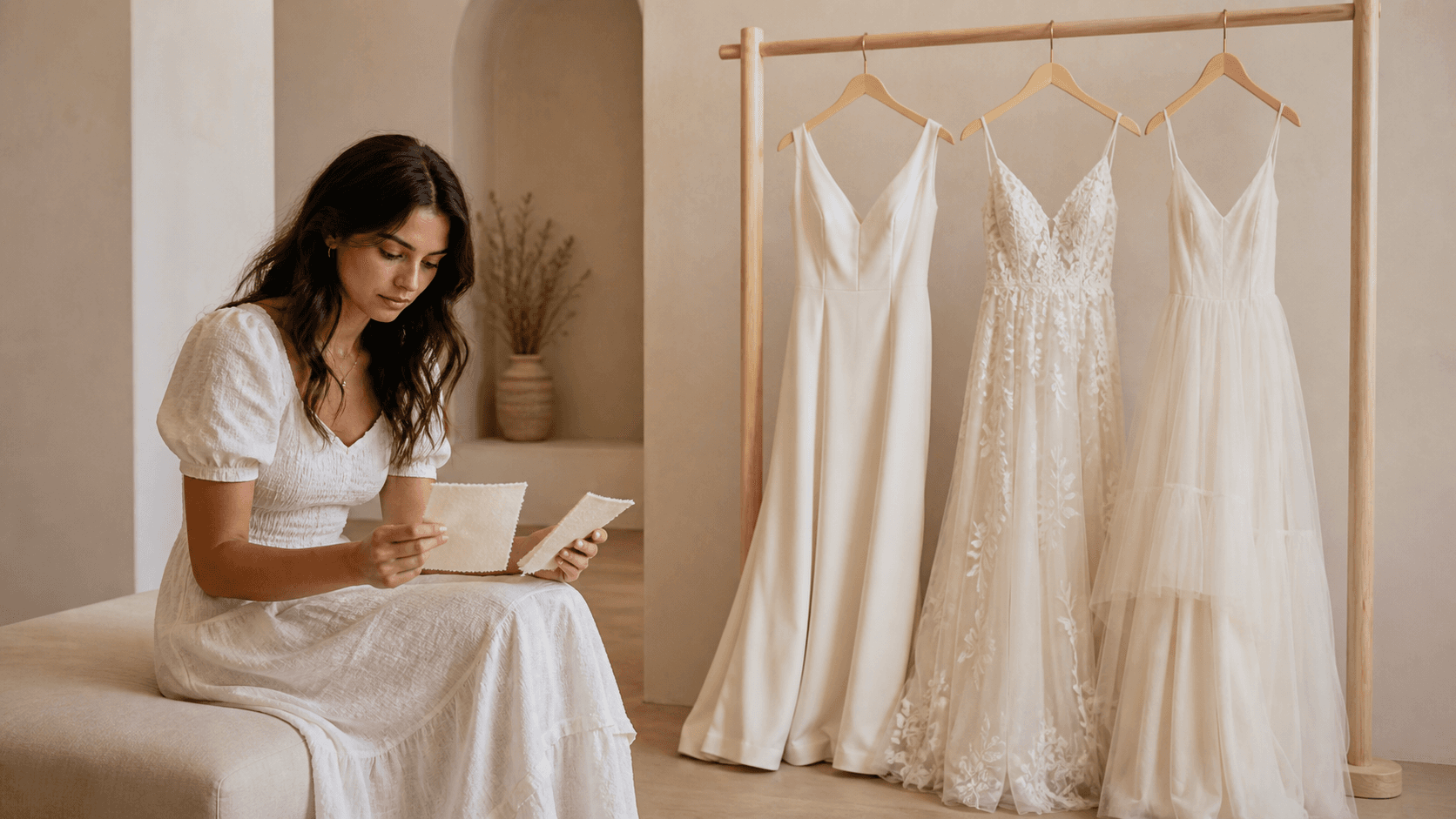
It is not the dramatic silence from the movies, where someone gasps, cries, and says yes while the room applauds. It is quieter than that. It happens after the stylist steps away. It happens when the bride turns slightly in the mirror, sees the waist settle exactly where she always wanted it, sees the fabric hold her body instead of fighting it, sees the person she hoped she might become on the day everyone looks at her.
Then she checks the tag.
The dream does not shatter all at once. It becomes a math problem first. Deposit. Alterations. Shoes. Veil. Taxes. Shipping. Credit card interest. The other dress she could buy. The honeymoon night she could add. The emergency fund she promised not to touch. The parent who said, "We want to help," and meant love, not leverage.
This week, bridal fashion made that private silence public.
On June 9, 2026, The Cut profiled a Wiederhoeft bridal ensemble built around a $13,900 corset and a $2,490 skirt. The story was not just about a price tag. It broke down why couture-level bridalwear costs what it costs: engineered corset sizing, custom steel boning, silk, hand embroidery, fittings, proportion work, and a designer's belief that a wedding garment should be precise enough to survive memory.
A day later, the same bridal-cost conversation pointed in the opposite direction: affordable wedding dress options for a difficult economy. On June 12, another piece asked whether a bride has to choose a traditional wedding dress at all, highlighting the rise of non-bridal white dresses as a way out of the wedding markup trap.
That whiplash is the story.
At one end of the aisle is the $16,000 dress, defended by labor, craft, fantasy, and the kind of construction most shoppers rarely get to see. At the other end is the browser tab full of affordable alternatives, rentals, resale listings, department-store whites, and "maybe this is good enough" carts waiting for checkout. In the background, the fast-fashion machine is no longer frictionless either: Axios reported in February 2026 that renewed tariff and de minimis uncertainty kept companies like Shein under pressure, reminding shoppers that cheap, instant fashion is also tied to policy, labor, shipping, and global risk.
Somewhere between those two worlds stands the bride most people know.
She is not trying to be irresponsible. She is not trying to cosplay wealth. She is not too shallow to understand that marriage matters more than fabric. She is trying to choose the one dress that will be photographed, judged, preserved, posted, compared, budgeted, remembered, and blamed if it feels wrong.
That is the part we keep pretending is simple.
The price is not the villain
It is tempting to look at a $16,000 wedding outfit and make it a moral test. Who needs that? Who spends that? Who does she think she is?
But a high price is not automatically an insult. Sometimes it is a receipt for visible and invisible labor. A corset that fits across many body types is not the same product as a stretchy bodice graded from a generic size chart. Hand embroidery is not the same promise as glued trim. A gown built for one body, one event, and one exact emotional pitch can carry hundreds of decisions the wearer will never see.
Brides know this more than they are given credit for. They know why some dresses cost more. They know why boning matters. They know why cheap satin photographs differently from heavy crepe. They know why a skirt can collapse, a seam can twist, and a bodice can look fine until someone raises an arm.
What hurts is not that expensive dresses exist.
What hurts is the suspicion that meaning itself has been priced out.
When the most beautiful version of a bride seems to live behind a number she cannot touch, the dress stops being a dress. It becomes a verdict. It says: this is what romance costs now. This is what taste costs. This is what it takes to look effortless in an economy where almost nothing feels effortless.
That is why the $16,000 gown lands so hard. Not because every bride wants that exact dress, but because every bride understands the fear underneath it: what if the thing that feels most like me belongs to someone else's budget?
The cheap dress can be expensive too
The other side of the story is less glamorous and just as brutal.
An affordable wedding dress can be a miracle. It can be smart, freeing, beautiful, and exactly right. A $300 dress that fits the venue, the body, and the life around the wedding is not a consolation prize. It can be the clearest possible choice.
But cheap becomes expensive when it buys panic.
The panic dress arrives late. The zipper sticks. The lining is sheer. The return window closes before alterations begin. The bodice needs more structure than the tailor can reasonably add. The bride orders three more options "just in case." She pays rush shipping twice. She buys shapewear to solve a construction problem. She loses weekends to tracking numbers and dressing-room fluorescent lights.
By the time the wedding comes, the low price has collected interest in stress.
This is the uncomfortable truth missing from many budget conversations: the goal is not to spend the least possible money. The goal is to spend in a way that reduces regret.
For some brides, that means vintage. For others, it means a department-store dress with excellent tailoring. For others, it means a custom wedding dress with one unforgettable detail instead of a rack gown covered in compromises. The right choice is not the cheapest or the most expensive. It is the one whose trade-offs are honest.
If you are trying to understand the trade-offs before you commit, our custom dress design cost guide breaks down where money actually goes: fabric, structure, labor, timeline, and fit. Our under-$1,000 wedding dress budget guide is also useful if the number matters as much as the neckline.
The wedding dress has become a public argument
A bride used to buy a dress for a room. Now she buys it for the room, the camera roll, the group chat, the wedding gallery, the vendor tags, the algorithm, the aunt who thinks sleeves are classier, the friend who wore Vivienne Westwood, the stranger who says it is "too simple," and the future self who will zoom in on the waistline in 2036.
No wonder everyone is tired.
The modern wedding dress has to perform too many jobs. It must be personal but legible. Fashionable but timeless. Bridal but not basic. Comfortable but sculpted. Photogenic but not costume. Expensive-looking but financially sane. Unique but not confusing. Emotional but not embarrassing.
That is not style. That is surveillance with lace on it.
This is where the conversation around bridal cost becomes more than shopping advice. A wedding dress is one of the last garments many women are openly permitted to care about with their whole chest. The culture tells brides, "It is your day," and then punishes them for taking the sentence seriously. Spend too much and you are vain. Spend too little and you are careless. Want something unusual and you are difficult. Want something classic and you are boring.
The bride is asked to be unforgettable, but never demanding.
That impossible instruction is what makes dress shopping feel haunted. The mirror is not just reflecting fabric. It is reflecting every expectation the bride has absorbed about femininity, money, beauty, family, taste, class, and control.
What the $16,000 dress really reveals
The unforgettable part of the $16,000 wedding dress is not the number. It is the clarity.
At that price point, the dress has to explain itself. It has to point to the handwork, the structure, the fitting system, the materials, the design language. It has to say: here is the labor, here is the craft, here is the reason.
Most wedding dresses do not have to explain themselves that well.
They rely on fog. "Premium." "Designer inspired." "Luxury feel." "Bridal quality." "Made for your moment." Those words can mean something, or they can mean almost nothing. The bride is left trying to decode whether she is paying for better construction or better lighting.
That is why transparency may be the real luxury now.
Not necessarily silk. Not necessarily hand beading. Not necessarily a famous label. Transparency: what is the fabric, what is the structure, what can be altered, what cannot, what timeline is realistic, what detail is worth the money, and what detail is just there to photograph well online.
When a bride understands the why behind the price, she can make a decision. When she does not, she is not shopping. She is guessing.
The dress worth remembering has a spine
If there is a lesson in this moment, it is not "spend more." It is not "spend less." It is this:
Choose the dress with a spine.
That may mean literal structure: boning, lining, a bodice that supports you, a skirt that moves, a fabric that does not betray you in bright light. It may mean design structure: one strong idea instead of twelve trends fighting each other. It may mean emotional structure: a clear reason you chose it that will still make sense after the feed has moved on.
Before buying anything, ask five questions that cut through the noise:
- What part of this dress do I want people to remember?
- What part of my body needs the dress to respect, not fight?
- What am I willing to pay for: fabric, structure, handwork, fit, speed, brand, or convenience?
- What am I not willing to sacrifice for the photo?
- If no one knew the price, would I still feel proud wearing it?
Those questions are sharper than "Is it worth it?" Worth is not a universal number. Worth is a relationship between the dress, the body, the budget, and the life waiting after the wedding.
For some brides, the answer will be a couture corset. For others, a vintage slip. For others, a made-to-measure gown with clean lines and one dramatic sleeve. For others, a non-bridal dress altered perfectly. The point is not to make every bride want the same kind of beauty. The point is to stop letting the industry confuse beauty with financial obedience.
A different kind of yes
The most powerful dress-shopping moment is not always the tearful yes in the salon.
Sometimes it is the bride closing the tab on a dress that would have made her anxious for a year. Sometimes it is choosing matte crepe over silk so the budget can hold. Sometimes it is saying no to a train because the wedding is on grass. Sometimes it is uploading three inspiration photos and writing, "I love this neckline, this waist, and this sleeve, but I need it simpler and under control."
That is not settling. That is authorship.
If you already know the feeling you want but cannot find the dress, start with the Build-a-Dress creator. If your idea lives in saved photos, upload your inspiration and use it as a design brief instead of a shopping spiral. You can also read our custom wedding dresses guide if you want the practical process behind made-to-measure bridal design.
The wedding dress people never forget is not always the most expensive dress in the room. It is the one with conviction. The one that understands the bride's body. The one that does not make her apologize for wanting beauty or punish her for having a budget.
In 2026, the question is no longer whether a wedding dress can cost $16,000. We already know it can.
The better question is whether every bride can find a dress that tells the truth about her life.
That is the dress worth saying yes to.