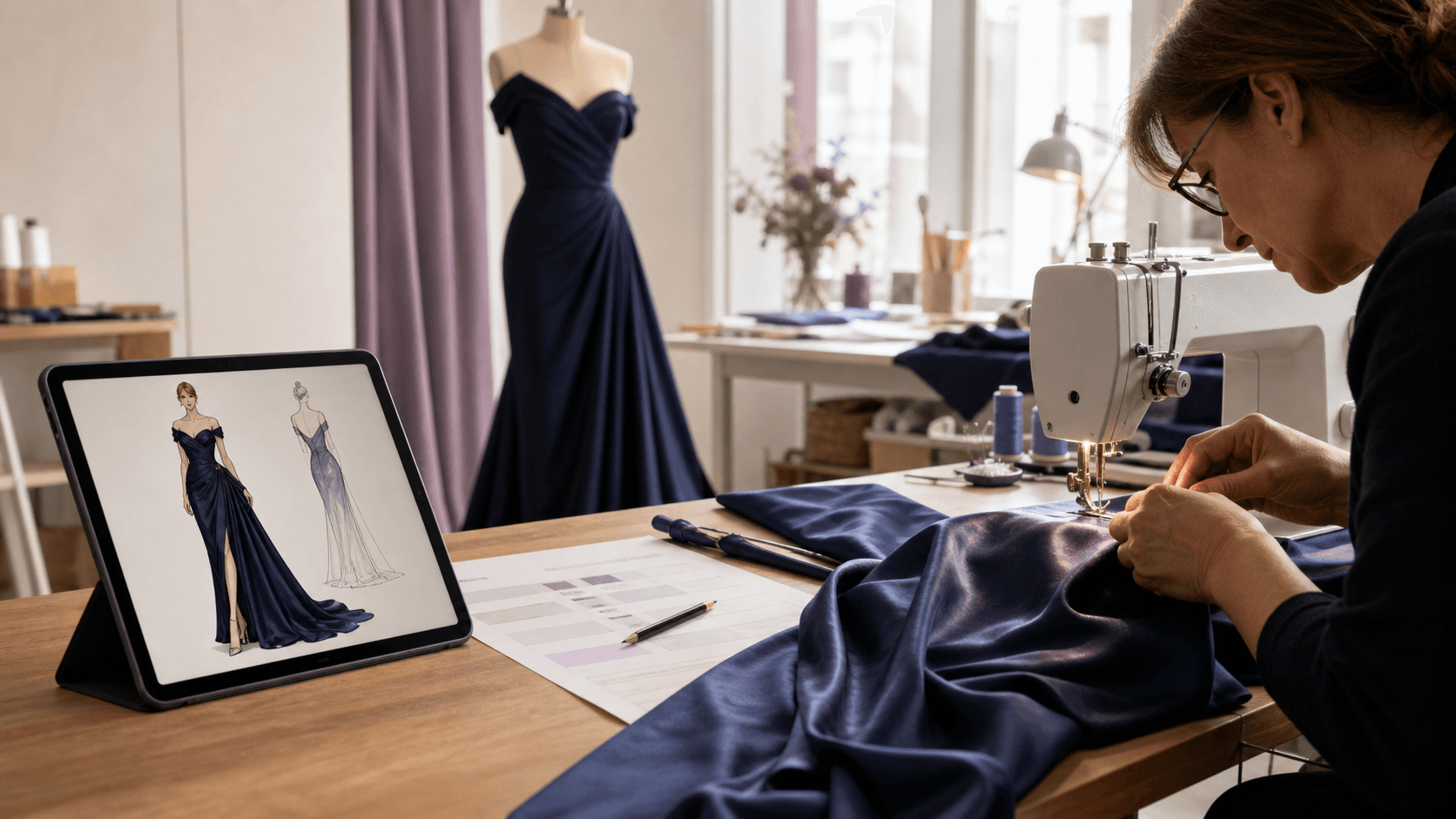
Custom Dress Maker: How to Choose One and Plan an Online Order
Custom dress maker guide: choose a verified maker, share inspiration, compare quotes, take measurements, and plan a 2-3 month timeline for weddings and prom.

If you’re searching for a custom dress maker, you’re probably trying to solve a specific problem: you want a dress that matches your vision and fits your body (not a generic size chart). Maybe you have inspiration photos you love but can’t find anything close in stores. Maybe you’ve tried on a dozen options and none of them sit right at the bust, waist, or hips. Or maybe you’re on a timeline for a wedding, prom, or a formal event and you don’t want last-minute alterations to be a gamble.
This guide breaks down how to choose a custom dress maker, what to ask before you commit, and how to communicate your design clearly so you get fewer surprises. You’ll also see how a managed online service differs from contacting an independent dressmaker directly.
If you want a clear starting point before you talk to any maker, you can design your custom dress maker concept online and use that as the brief you refine with quotes and feedback.
What a custom dress maker does (and what you should expect)
A custom dress maker (sometimes called a dressmaker) turns your idea into a wearable garment—usually starting from measurements, not standard sizes. Depending on the maker, that work can include design guidance, pattern drafting, fabric sourcing, sample fitting, and final construction.
If you’re new to the terminology, Fashion Institute of Technology has accessible resources on fashion design fundamentals.
It helps to know the difference between common roles:
- Dressmaker: Creates a dress from scratch (pattern + construction) based on your measurements.
- Tailor/alterations specialist: Adjusts an existing garment; great for fit fixes, not full custom design.
- Designer: Focuses on the concept and sketch; sometimes also makes the garment, sometimes partners with a maker.
- Manufacturer: Produces the garment with a team; often better at repeatable quality control, timelines, and scaling.
When you work with a custom dress maker, “success” usually depends on three things:
- A clear brief: You can describe what you want (and what you don’t).
- Accurate measurements: The best construction can’t fix incorrect numbers.
- Realistic constraints: Fabric, complexity, and deadlines have tradeoffs.
How to vet a custom dress maker: a practical checklist
Choosing the right custom dress maker is less about vibes and more about evidence. Here’s a checklist you can use quickly.
Portfolio proof (not just pretty photos)
Look for photos that show fit and construction, not only styled shoots.
- Fit angles: front/side/back on real bodies.
- Detail shots: seams, closures, hems, boning, lining, cups.
- Similar complexity: corset structure, lace applique, beading, slits, trains, etc.
If the portfolio is all heavily edited or only mannequin shots, ask for unfiltered client photos.
Process clarity
A reliable custom dress maker can explain their workflow in plain language:
- How many revision rounds are included?
- How do they confirm fabric and color (swatches, photos, references)?
- What happens if you change your mind midstream?
- How do they handle measurement confirmation?
Unclear process is one of the biggest sources of disappointment in custom work.
Communication and decision points
Before you pay, make sure you know:
- Where you’ll communicate (messages, email, calls) and typical response time
- What you approve (sketch, fabric choice, final measurements, progress photos)
- How changes are priced (flat fee vs. itemized)
The best makers don’t just “take orders”—they help you make decisions at the right moments.
Quality signals you can actually verify
If you can, look for measurable signals:
- Years in business
- Verified status (platform verification, identity, business verification, track record)
- Reviews/ratings (and how recent they are)
- Repeat client work (multiple dresses, bridal parties, ongoing relationships)
Share your vision clearly: the brief that helps a custom dress maker succeed
Most custom dress problems are communication problems. A custom dress maker can’t read your mind—but they can work from a strong brief.
Start with inspiration (and annotate it)
Collect 3–8 images that represent what you want. Then annotate what matters:
- “I love this neckline, but I want sleeves like photo #3.”
- “I want this silhouette, but less volume in the skirt.”
- “Keep it minimal—no sparkle, no lace.”
If you already have images, the fastest way to get aligned is to upload inspiration photos for your custom dress maker brief so the design can be referenced clearly from the start.
Define your non‑negotiables (and your flex areas)
Write a short list:
- Must-haves: neckline, sleeve length, hem length, level of modesty, support (boning/cups), pockets, etc.
- Must-not-haves: itchy lace, heavy beading, low backs, high slits, anything that feels unsafe.
- Flexible: fabric type, exact shade, embellishment level, train length.
This helps your maker prioritize what matters most to you.
Give a budget range and a timeline upfront
Budgets without ranges are hard to quote. Timelines without event dates are risky. Be specific:
- Budget range: include shipping and expected alterations.
- Event date: include time for delivery and optional local tweaks.
On Build‑a‑Dress, many customers plan around “Design in 2 Minutes, Wear Your Custom Dress in 2-3 Months,” with custom dresses commonly starting at $650 depending on fabric and complexity.
If you’re comparing fabrics and drape, Textile World is a solid reference for how materials behave and how to care for them.
Use a “fit reference” if you have one
If you own a dress that fits well, note what you like about it:
- “Snug at the waist, relaxed at the hips”
- “Strap placement is perfect; please match this”
- “I need more room in the bust than standard sizing”
Fit preferences help a maker interpret measurements the way you expect.
Compare the maker and the order scope
When contacting an independent dressmaker, ask who will construct the garment, request completed-work examples, and read their terms. If you compare several providers, check more than the headline price:
- Garment scope: fabric, lining, support, decoration, and detachable pieces.
- Timing: production and shipping, plus a local-fitting buffer.
- Changes: what can change before and after production begins.
- Measurements: what is needed and how unclear measurements are resolved.
- Remedies: what happens if the garment has a defect or differs materially from the confirmed order.
Build-a-Dress uses a managed workflow. Create a front preview, choose Get free quote, and sign in or create an account when prompted to receive an automated estimate. That estimate is not a competing bid from a seamstress. After checkout, the team coordinates the order with a production partner.
Read how Build-a-Dress works, inspect the documented finished-dress example and maker, and review the Refund Policy.
Timeline and fit: from design to delivery in about 2-3 months
For Build-a-Dress, 2–3 months from confirmation to delivery is a typical planning estimate. Leave additional time for design decisions and an optional local fitting; confirm the schedule before ordering.
- Share the direction: describe the dress or upload reference images.
- Refine a visual concept: record important requirements in the dress ticket.
- Request an instant estimate: create a front preview, choose Get free quote, and sign in or create an account if prompted.
- Review the order and measurements: clarify materials, scope, and timing before proceeding.
- Move into production: after checkout, the team coordinates work with a production partner.
- Track delivery and assess fit: allow for a local fitting and possible finishing adjustments.
To avoid fit surprises, treat measurements as a critical step:
- Measure over the undergarments you plan to wear.
- Don’t pull the tape too tight.
- Re-measure key points (bust, waist, hip) twice.
- If this is a major event dress, consider professional measurements.
For general fit and fashion guidance, Vogue's fashion guides can be a useful starting point.
Frequently asked questions
What evidence should I look for in a maker's work?
Look for photos or video of completed garments, an identified maker, and clear explanations of materials and construction. A generated concept alone does not establish workmanship or fit. Our customer example lets you compare a concept with finished-dress media.
How early should I start for a wedding or prom?
Plan around 2–3 months from confirmation to delivery, then add time for design decisions and an optional local fitting. Check your deadline before ordering, especially for complex structure or particular material requirements.
Can I use photos to match a style I like?
Yes—and photos work best when you annotate what you want to keep versus change. If you want to begin from visuals, upload inspiration photos for a custom dress design so your custom dress maker has a concrete reference.
What if I need alterations after it arrives?
Even made-to-measure dresses sometimes benefit from minor local alterations (strap length, hem, small waist adjustments). Ask your maker about seam allowances and alteration friendliness before production starts.
How do I start if I only have a text description, not photos?
Write a short paragraph describing the silhouette, neckline, sleeves, fabric feel, and vibe (“minimal,” “romantic,” “dramatic,” etc.). AI design tools can turn that into a visual starting point that you and your maker can refine.
Conclusion
The right custom dress maker is the one who can prove quality, explain their process, and communicate clearly—because custom success is mostly about alignment. Start by vetting portfolios for real fit and construction, write a short brief with non-negotiables, and give your budget and timeline upfront. For a managed service, establish who coordinates production and what your quote covers before you commit.
If you’re ready to turn your idea into a clear starting point, you can start designing with a custom dress maker online and refine the details from there.
Compare occasion-specific options for custom wedding dresses, custom prom dresses, and custom formal dresses. Our cost guide explains the current starting price and historical manufacturer-quote data.